A mark made of the mechanism.
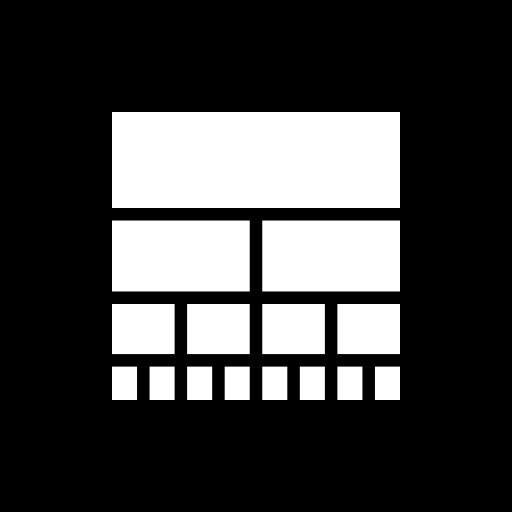
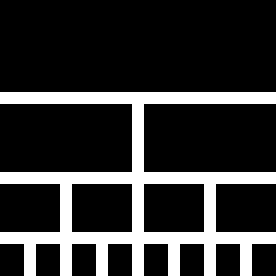
The Siontology mark is the Fold drawn as a partition: eight leaf proofs folded pairwise into four, two and one World Proof. The rest of the identity has the network’s job, making proofs easy to read: black and white, one red for refusals, a wide grotesque for statements and a monospace for anything you can type.
The mark
The mark is a full binary tree drawn as a partition of a square, the way the hero animation folds proofs: eight leaf proofs at the bottom, joined pairwise into four, then two, then the one World Proof that spans the top. It is built from rectangles on a 69-unit grid, so it can be drawn exactly in any medium.
Below 40 pixels, use the small mark: three rows of one, two and four cells on a 22-unit grid, with every edge on an even unit, so it stays sharp at 16 pixels.
- Clear space: keep at least the height of the top row, a third of the mark, clear on every side.
- Lockup: the mark is 1.1 times the cap height of the wordmark and sits on its baseline; the gap is 0.42 times the mark. Use the files rather than rebuilding it.
- Colour: solid white on black, or solid black on white. Nothing else.





The name
Siontology
One word, with a capital S and the rest in lower case, in headlines and running text alike. Never set it in capitals; the wordmark is not in capitals either. Don’t shorten it to Sion.
sionThe command-line tool, in code style and lower case. The crates are
sion-core,sion-execand so on, and the environment variables areSION_NODEandSION_CHAIN.neo-blockchain
The category, in lower case with a hyphen. It describes Siontology; it is not a name.
Mechanisms
Capitalised as names: Pulse, the Fold, World Proof, Linear Lanes, Escrow Lanes, Contention Consensus, the Assurance Algebra, Verifiable Clearing, Agent Charters. Forced inclusion and data-availability sampling stay in lower case.
ColdAI
The organisation that publishes Siontology. Written as one word, with AI in capitals.
Colour
Colour is achromatic on purpose, so that a diagram’s meaning is carried by shape and not by hue. Dark is the signature look; light is its exact inverse, for print and for readers who prefer it. The one hue, signal red, means a refusal: a conflicting spend, a withheld share, a payment the ledger refused. It is never decoration, never a highlight and never a button.
Dark, the signature
#000000#0e0e0e#f5f5f5#b8b8b8#848484#262626#4d4d4d#ff5a4cLight
#ffffff#f4f4f4#000000#3d3d3d#676767#dcdcdc#a3a3a3#c4271bInk 3, the faintest text colour, has a contrast of 5.6:1 on the background in both themes. Signal red has 5.7:1 on white and 6.8:1 on black, so a refusal is always legible as text.
Typography
One family carries the voice: Archivo, a variable grotesque whose width axis does the work that weight usually does. Statements are wide rather than bold; running text is normal width. Fragment Mono is only for things you can type or compute: commands, identifiers, hashes and formulas. Greek letters and logic operators come from a 9 KB subset of Noto Sans Math. All three are under the SIL Open Font License and are served from this site.
Display
Archivo, width 125, weight 480
Folded, not chained.
Statement
Archivo, width 118, weight 500
Trust becomes a number.
Heading
Archivo, width 106 to 112, weight 560 to 600
Two levels of finality
Text
Archivo, width 100, weight 400, 17 px on 1.58
A claim’s formula names the assumptions it rests on, and any consumer computes what an attacker would have to spend or forfeit to falsify it.
Code
Fragment Mono, weight 400
sion demo all --local
Formulas
Fragment Mono with Siontology Symbols
min(δ·CoClow(c), CoC(adj)) ≥ κ·V φ = lattice ∨ hash
Write headings in sentence case, and never set labels in capitals. Numbers use tabular figures where they line up in columns.
Motion
Motion explains a mechanism or it does not happen. Every animation on this site is a faithful run of one mechanism, with numbers from a demo or the architecture paper, a caption that says what it shows and its status in the code. The cadence is the Pulse: one beat a second. Animations are calm, loop slowly, pause when they leave the screen or when the reader presses Pause, and show a single labelled frame to readers who ask for reduced motion.
The one exception is an agent’s face. Where the site shows agents to people rather than a protocol at work, a diamond may have eyes of solid cells and a mouth of lines, which blink, look about and follow the pointer, slowly, to show that the agent is at work. They stop with a Pause button too, and start paused for readers who ask for reduced motion.
| Token | Value | Use |
|---|---|---|
--duration-pulse | 1000 ms | One Pulse: the beat of every protocol animation |
--duration-fold | 720 ms | Two cells joining into one, with --ease-fold |
--duration-base | 240 ms | Interface changes, with --ease-standard |
--duration-fast | 160 ms | Hover and press |
Diagrams and icons
Diagrams are drawn, not illustrated: square cells on a grid, hairline rules and labels in sentence case. Shapes keep one meaning on every page, so a reader who has learned one figure can read the next.
Voice
Plain, exact and honest about status. Say what something does, in the active voice and in sentence case. Give every number its unit and its source, and say whether it was measured or is a design target. Say what is simulated before anyone has to ask.
| Write | Not |
|---|---|
| Designed so that a phone can check the whole history. Today the proofs are checked by replay. | Verify the entire chain on your phone, instantly. |
| Design target: 100,000 operations a second on a testnet. | 100k TPS. |
| The ledger refuses the payment: payee not allowed. | Our AI keeps your agents safe. |
| Post-quantum signatures from two unrelated families. | Quantum-proof. Unhackable. |
Do and don’t
Do
- Use the supplied files, and scale them proportionally.
- Put the white mark on black and the black mark on white.
- Keep a third of the mark clear on every side.
- Use the small mark below 40 pixels.
- Label every number as measured or as a design target.
- Name the demo, specification or code behind a diagram.
Don’t
- Recolour, outline, stretch or rotate the mark, or add shadows, gradients or effects.
- Rearrange, redraw or add cells.
- Set the name in capitals or split it in two.
- Use signal red for decoration, emphasis or buttons.
- Use the mark to suggest that ColdAI endorses another project.
- Discuss price, returns or investment. Siontology has no token and nothing is on offer. Fees are paid in stablecoins.
Press kit
About Siontology
Siontology is an open-source neo-blockchain published by ColdAI. Its product is verified knowledge rather than ordered transactions: every claim, whether about a payment, a computation, an AI output or an event in the world, carries a proof or priced evidence, and every Pulse the proofs fold into one World Proof. The reference implementation is written in Rust and licensed Apache-2.0 OR MIT. It runs as a devnet: its succinct proofs are simulated, networking between machines is simplified, and there is no mainnet.
- Mark, on darkSVG
- Mark, on lightSVG
- Small mark, on darkSVG, for 16 to 32 px
- Small mark, on lightSVG, for 16 to 32 px
- Wordmark, on darkSVG
- Wordmark, on lightSVG
- Lockup, on darkSVG
- Lockup, on lightSVG
- App iconSVG; PNG, 512 px
- FaviconSVG; PNG, 32 px; PNG, 180 px
- Social imagePNG, 1200 × 630; SVG
- Design tokensCSS; JSON