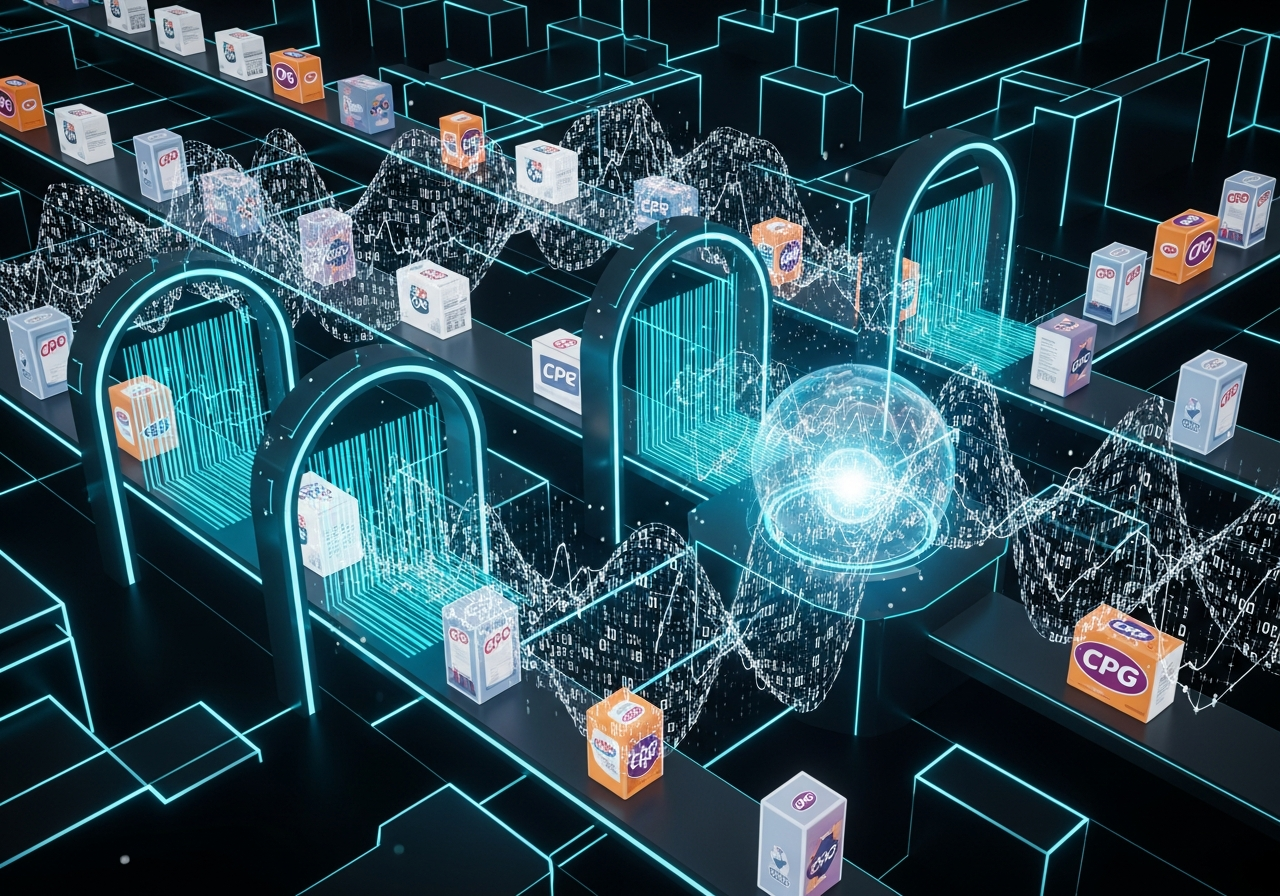
Consumer Packaged Goods
Updated
DTC + Retail
Unified demand sensing across direct and channel sales
Trade promo
AI-driven trade promotion optimisation, replacing rule-based planning
Last-mile
Real-time visibility from raw-material sourcing to delivery
What does ColdAI do for Consumer Packaged Goods?
ColdAI builds AI systems for consumer packaged goods manufacturers in four areas where decisions repeat every week: revenue growth management, demand and supply planning, consumer insight and product development. Most of the work draws on data a manufacturer already holds but rarely joins up, such as shipments, retailer sell-out, promotion calendars and trade spend. The value depends on getting that foundation right before any model is trained.
“CPG margins are being squeezed from both sides — input costs and channel power. AI-driven trade-promotion optimisation is the single largest unsweated lever still on the table.”
In depth
Go deeper into CPG planning and compliance
Method pages for three recurring CPG questions: whether past promotions paid back, what demand sensing adds to planning, and how HFSS rules constrain a promotion calendar.
- 01ProcessTrade promotion post-event analysis with machine learningA step-by-step method for trade promotion post-event analysis: baselines, incremental lift, pull-forward, cannibalization and fully loaded ROI per retailer.
- 02ComparisonDemand sensing vs demand planningHow demand sensing differs from demand planning in horizon, inputs, owners and metrics, where each sits in S&OP, and when sensing earns its place in CPG.
- 03Regulation explainerHFSS promotion rules for CPG plannersWhich HFSS promotions, placements and adverts are restricted in England, Wales and Scotland, how the nutrient profiling test works and how to check plans.
Intelligent CPG Operations
Consumer packaged goods companies face relentless pressure — shrinking margins, shifting consumer preferences, retail channel fragmentation, and supply chain volatility. The winners are those that embed AI into every layer of operations: from demand sensing and dynamic pricing to personalized marketing and sustainable packaging design. ColdAI builds the data and AI infrastructure that transforms CPG companies from reactive to predictive.
Use Cases We Deliver
AI Demand Sensing
Real-time demand forecasting that incorporates POS data, weather, social media sentiment, and economic indicators to predict consumer purchasing behavior days and weeks ahead.
Dynamic Pricing & Promotion
AI-optimized pricing engines that analyze competitive positioning, elasticity curves, and channel-specific dynamics to maximize margin across retail partners.
Consumer Intelligence
360-degree consumer profiles built from transaction data, digital engagement, and third-party signals to drive personalization across marketing and product development.
Supply Chain Digitization
End-to-end visibility from raw materials through last-mile delivery with predictive disruption alerts, inventory optimization, and logistics route planning.
Trade Promotion Optimization
ML-powered analysis of historical trade promotion effectiveness to optimize future spend allocation, timing, and mechanics across retail channels.
New Product Development AI
Consumer trend analysis, concept testing simulation, and demand estimation for new products before market launch — reducing the failure rate of new SKU introductions.
How We Help Across CPG
| Function | Challenge | ColdAI Solution |
|---|---|---|
| Marketing | Fragmented channels and rising acquisition costs | Consumer intelligence, personalization, attribution modeling |
| Supply Chain | Demand volatility and inventory costs | AI demand sensing, inventory optimization, disruption prediction |
| Revenue Management | Margin compression and promotional waste | Dynamic pricing, trade promotion optimization, elasticity modeling |
| R&D | High failure rate of new product launches | Trend analysis, concept simulation, demand forecasting |
Our CPG Delivery Process
Data Landscape Mapping
Assess POS data, marketing systems, supply chain platforms, and consumer data sources to build a unified analytics foundation.
Use Case Prioritization
Identify and rank AI opportunities by business impact, data readiness, and time-to-value across marketing, supply chain, and R&D.
Rapid Prototyping
Build and test AI models on historical data with A/B testing frameworks to validate business impact before full deployment.
Enterprise Scale Deployment
Production deployment with integration into existing ERP, TPM, and marketing platforms with ongoing model monitoring and retraining.
Why CPG Companies Choose ColdAI
- AI systems that process retail POS data, social signals, and economic indicators for comprehensive demand intelligence.
- Proven pricing and promotion optimization models that measurably improve margin per SKU.
- Supply chain platforms that provide true end-to-end visibility across complex multi-tier supplier networks.
- Consumer analytics that comply with GDPR, CCPA, and evolving data privacy regulations.
Four CPG decision areas and what AI changes in each
For each area: the recurring decision, the data behind it, and where judgment should stay with people.
| Decision area | Recurring decision | Data it rests on | Where models help | Where people stay in charge |
|---|---|---|---|---|
| Revenue growth management | Which price points, pack sizes, mechanics and trade terms to agree with each retail customer. | Shipments, retailer sell-out, promotion history with mechanics and depth, list prices, trade spend and deductions. | Estimating price elasticity, measuring past promotions and simulating a proposed calendar before negotiation. | Customer strategy, negotiation, and any choice that trades short-term margin for a retail relationship. |
| Demand and supply planning | How much to make, where to hold it and how to deploy stock across distribution centers and customers. | Order and shipment history, shared retailer inventory and sell-out, promotion plans, production constraints and lead times. | Statistical baselines, short-horizon adjustments from fresh signals, and flagging forecasts that need attention. | The consensus number in S&OP or IBP, capacity trade-offs, and events with no precedent in the history. |
| Consumer insight | Which needs, complaints and emerging tastes deserve a brand team's attention this quarter. | Ratings and reviews, service contacts, panel and survey data, search trends and social conversation. | Classifying and summarizing unstructured feedback at volume, and spotting themes that grow over time. | Deciding what a theme means for the brand, and checking it is not an artifact of who chose to post. |
| Product development and renovation | Which concepts to take forward, which products to reformulate and which nutrient or cost targets to set. | Recipe and specification data, ingredient costs, nutrition values, concept test results and launch history. | Screening concepts against past launches and estimating how recipe changes move nutrient scores and cost. | Sensory judgment, brand fit, and any claim that will appear on pack or in advertising. |
Read across a row for what one use case needs; read down a column for the data several use cases share.
Why AI for a manufacturer differs from AI for a retailer
A retailer sees every basket, price and shelf it controls. A CPG manufacturer sees its own shipments into a customer's warehouses and, depending on the agreement, some or all of what happens after that. Sell-out data may arrive through a retailer portal, a syndicated data provider or not at all, and it usually lands later than the manufacturer's own orders.
The gap shows up in three ways. Shipments and consumption diverge whenever a retailer buys ahead of a promotion or runs stock down afterwards, so a model trained only on shipments learns ordering habits rather than shopper demand. Trade spend settles late, because deductions and scan-back claims arrive weeks after an event. And shared retailer data is often licensed for specific uses, which decides what a manufacturer may train on and keep.
None of this rules AI out. It means the first piece of work is usually an inventory of which signals exist per customer, how late each arrives and what each may be used for. The retail industry page covers the same problems from the store operator's side.
Data foundations to check before a CPG AI project starts
Use this list in a first workshop with commercial, supply chain and IT leads. Each unchecked item is a likely source of delay, not a reason to stop.
Choosing a first CPG use case from the question under most pressure
Good starting points differ by the decision that hurts most today.
- If
Trade spend is one of the largest discretionary lines and nobody agrees whether last year's promotions paid back.
ThenStart with measurement, using a post-event analysis method that separates incremental volume from pull-forward and cannibalization.
Optimization built on unmeasured history repeats the old calendar with more confidence.
- If
Service misses and excess stock appear at the same time, and plans change faster than the monthly cycle.
ThenAssess whether short-horizon signals would improve deployment, using the demand sensing and demand planning comparison.
Sensing helps only where fresh data exists and someone can act on it inside the lead time.
- If
You sell cereals, snacks, confectionery or other listed categories through retailers in England, Wales or Scotland.
ThenBuild nutrient-profile checks into promotion planning before any optimization work, following the HFSS promotion rules explainer.
An optimized promotion that a retailer cannot legally run has no value.
- If
An ingredient or packaging disruption has already cost a launch or a promotion window.
ThenLook at continuous supplier monitoring, described in the supplier risk monitoring use case.
Earlier warning gives planners time to re-sequence production or qualify substitute materials.
Failure patterns specific to CPG AI programs
Forecasting shipments instead of consumption
Early signalForecast error spikes around every promotion and around quarter ends.
MitigationModel sell-out where it is available, and treat shipments as the product of retailer ordering policy rather than as demand.
Promotion history without mechanics
Early signalPast events are recorded only as dates and a total spend figure.
MitigationBackfill mechanic, depth and support for the most recent seasons before training anything on promotions.
Retailer data used beyond its license
Early signalNobody can say which agreement covers a feed or whether it permits model training.
MitigationRecord usage rights per feed and enforce them in the data platform, including deletion when an agreement ends.
Generated claims reaching packs or adverts unchecked
Early signalGenerative tools draft product copy that mentions health, nutrition or sustainability.
MitigationRoute such wording through regulatory review against the nutrition and health claims rules in Regulation (EC) No 1924/20064, or its assimilated version in Great Britain; the generative AI marketing compliance guide covers disclosure.
Consumer data processed without a lawful basis
Early signalLoyalty, direct-to-consumer or panel data copied into analytics environments without a recorded purpose.
MitigationApply the GDPR, the CCPA and similar laws from the design stage, with minimization and retention limits built into the pipelines.
How ColdAI runs CPG engagements
Engagements usually begin with a short assessment. ColdAI's consulting practice runs sprint assessments of two to four weeks1, and for CPG companies that work maps the POS, marketing, supply chain and consumer data sources in use, then ranks candidate use cases by business impact, data readiness and time to value.
Selected use cases move to prototypes tested on historical data before anything touches live planning. Production work follows ColdAI's development practice of two-week sprints that each end in deployable software, with design choices recorded as architecture decision records2, integrated with the ERP, trade promotion management and marketing systems already in place. Where data must stay inside the company's own infrastructure, models can run on premises or in a private cloud through enterprise AI deployments.
Manufacturers selling into the EU can read the PPWR compliance guide alongside the method pages below.
Frequently asked questions
Do CPG manufacturers need retailer sell-out data before using AI?
Not for every use case. Consumer insight work runs on reviews, service contacts and survey data a manufacturer already holds, and supply planning can start from orders and shipments. Promotion measurement and demand sensing are different: without sell-out from retailer portals or syndicated sources, you are modeling the retailer's ordering behavior rather than shopper demand. A sensible first step is to list which customers share which data, how late it arrives and what the agreements allow.
Is generative AI useful in CPG, or is the value mainly in forecasting and optimization?
Both have a place, for different jobs. Forecasting, elasticity and optimization models handle numeric decisions such as volumes, prices and promotion calendars. Language models suit unstructured work: summarizing consumer feedback, drafting briefs, answering planners' questions about data, or extracting terms from retailer agreements. Anything generated that could reach a pack, an advert or a retailer submission should be reviewed by a person who owns the claim.
Can AI models run alongside our existing ERP and trade promotion management systems?
Yes, and in most cases they should. Models typically read from the ERP, the trade promotion management tool and the data warehouse, then write recommendations or flags back into the screens planners already use. Replacing a planning system is a separate decision with its own business case. Integration effort depends mainly on how consistent product, customer and promotion identifiers are across those systems.
How should consumer data privacy be handled in CPG analytics?
Treat consumer data from loyalty schemes, direct-to-consumer sales, competitions and service contacts as personal data from the start. Record a lawful basis and purpose for each use, minimize fields before data reaches analytics environments, and set retention limits. In the EU and UK that means the GDPR and its UK equivalent; in California, the CCPA as amended. Aggregated sell-out data rarely raises the same issues, though its license terms still apply.
Where should a mid-sized CPG brand start with AI?
Usually with the decision that consumes the most money or planner time and already has data behind it. For many brands that is trade promotion spend, because past events can be measured before any optimization is attempted. For others it is consumer feedback, where language models can sort large volumes of reviews cheaply, with analysts checking each theme. A short assessment that ranks candidates by value and data readiness keeps the choice grounded.
Sources
Applied
Use cases in Consumer Packaged Goods
Latest analysis from this industry
Leading CPG Brands Are Replacing Demand Planners With Autonomous Agent Networks. Here’s what changed
Three enterprise deployments reveal how agentic systems now outperform human teams on forecast accuracy while cutting planning cycles from weeks to hours.
Field notes: CPG Demand Sensing Accuracy Is Collapsing Despite Better AI Models
The best forecasting algorithms can't save demand plans when product hierarchies, promotional calendars, and pricing taxonomies remain siloed across legacy ERP systems.