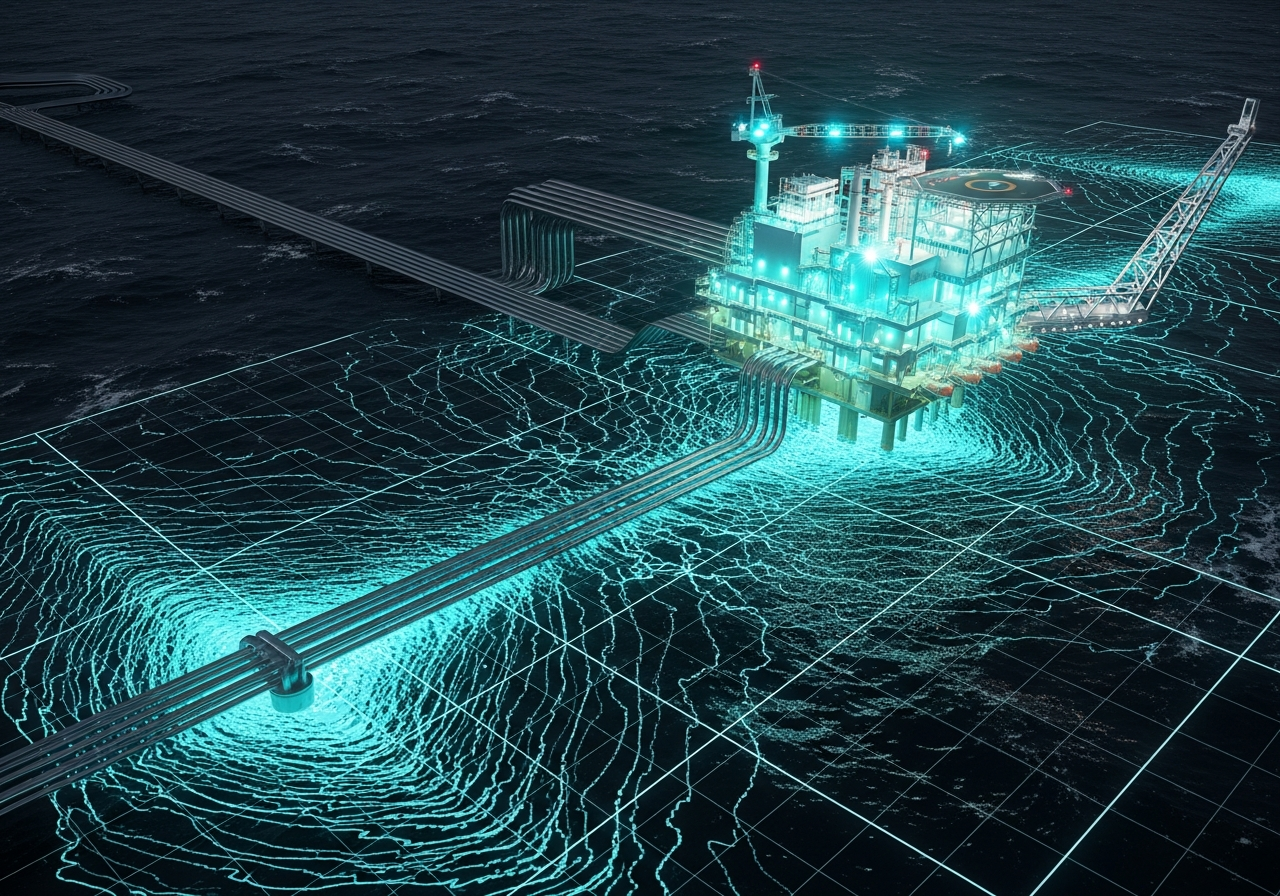
Oil & Gas
Updated
Upstream-Downstream
Single platform from reservoir modelling to retail forecourts
Predictive
Asset integrity and turnaround planning across rotating equipment
Carbon
Emissions monitoring and reporting integrated to operations
What does ColdAI do for Oil & Gas?
ColdAI's oil and gas practice builds AI and data systems for upstream, midstream and downstream operations: subsurface interpretation, production surveillance, pipeline integrity, refinery support and emissions measurement. In this sector a model that drifts can influence a pressure setting or a repair schedule, so we design each deployment as part of a safety-critical system, with engineering sign-off, defined operating limits and records a regulator can follow.
“An asset-integrity event in oil and gas is measured in lives, not just in dollars. Predictive maintenance here is a safety system before it is an efficiency system.”
In depth
Go deeper into oil and gas AI
Detailed pages on methane reporting under EU rules, integrity analytics on inspection data and per-well flow estimation, written for the engineers who own those decisions.
- 01Regulation explainerEU Methane Regulation and OGMP 2.0 Level 5 reportingWhat Regulation (EU) 2024/1787 asks of oil and gas operators and importers: MRV, leak detection, venting limits, and the data system OGMP 2.0 Level 5 needs.
- 02ProcessPipeline integrity: from ILI data to a dig listA step-by-step process for applying machine learning to in-line inspection and operating data to rank pipeline digs, aligned to PHMSA rules and ASME B31.8S.
- 03ComparisonVirtual flow metering: physics, data-driven or hybrid?Physics-based, data-driven and hybrid virtual flow meters compared on data needs, drift, uncertainty and upkeep, and how to validate them against well tests.
Intelligent Oil & Gas Operations
Oil and gas companies operate some of the world's most complex and capital-intensive infrastructure — from deepwater platforms to continent-spanning pipelines and global refinery networks. AI is transforming upstream exploration, midstream transportation, and downstream processing by enabling predictive operations, optimized production, and enhanced safety. ColdAI builds the AI and digital twin platforms that maximize asset value while reducing operational risk across the hydrocarbon value chain.
Use Cases We Deliver
AI Reservoir Modeling
Machine learning models that analyze seismic data, well logs, and production history to optimize reservoir characterization, drilling placement, and recovery factor estimation.
Pipeline Integrity Monitoring
AI-powered analysis of inline inspection data, SCADA readings, and environmental conditions to predict corrosion, fatigue, and third-party damage across pipeline networks.
Production Optimization
Real-time optimization of well operations, artificial lift, and facility throughput using AI models that balance production rate, cost, and equipment constraints.
Refinery Digital Twins
Virtual replicas of refinery units that simulate process changes, catalyst performance, and maintenance scenarios to optimize crude diet, product mix, and energy consumption.
Emissions Monitoring & Reduction
Methane leak detection using satellite and drone-based sensors with AI classification, LDAR compliance automation, and emissions reduction pathway modeling.
Process Safety AI
Real-time monitoring of process safety parameters with AI that detects abnormal operating conditions and recommends corrective actions before safety limits are breached.
How We Help Across Oil & Gas
| Segment | Challenge | ColdAI Solution |
|---|---|---|
| Upstream E&P | Reservoir optimization and drilling efficiency | AI reservoir modeling, drilling optimization, production AI |
| Midstream | Pipeline integrity and throughput | Integrity monitoring, flow optimization, leak detection |
| Downstream Refining | Yield optimization and energy costs | Digital twins, process optimization, crude selection AI |
| LNG | Liquefaction efficiency and scheduling | Process optimization, cargo scheduling, demand forecasting |
Our Oil & Gas Technology Delivery Process
Asset & Operations Assessment
Review production assets, pipeline networks, refinery operations, and data infrastructure to prioritize AI deployment opportunities.
Safety-Critical System Design
Architecture design meeting API, NORSOK, and IEC 61511 safety requirements with hazard analysis and SIL certification support.
Field Pilot & Validation
Deploy AI systems on selected wells, pipeline segments, or process units with comprehensive safety monitoring and performance validation.
Enterprise Deployment
Scale across the asset portfolio with integration into existing SCADA, historian, and production management systems.
Why Oil & Gas Companies Choose ColdAI
- Reservoir modeling AI that improves recovery factor estimates and optimizes drilling programs.
- Pipeline integrity platforms that integrate with existing SCADA and GIS infrastructure.
- Refinery optimization models with proven capability to increase throughput while reducing energy consumption.
- Emissions monitoring that prepares operators for evolving methane regulations and carbon pricing.
AI across the oil and gas value chain, segment by segment
Each segment has its own data, its own decisions and its own accountable engineer. Starting from the decision rather than from the data keeps projects small enough to validate.
| Segment | Where models help | Data they depend on | Who signs off |
|---|---|---|---|
| Subsurface | Seismic interpretation support, well-log facies classification and search across legacy field studies | Seismic volumes, well logs, core data and old reports | Geoscientists and the reservoir management team |
| Drilling and completions | Detecting drilling dysfunction, rate-of-penetration advice and offset-well comparison | Rig sensor streams, daily drilling reports and offset well records | Drilling superintendent and well engineer |
| Production operations | Virtual flow metering, artificial lift surveillance and deferment analysis | Downhole and wellhead gauges, well tests and historian data | Production engineer |
| Pipelines and storage | Corrosion growth and dig prioritisation, leak detection support and compressor condition monitoring | Inspection runs, cathodic protection surveys and SCADA history | Integrity engineer and pipeline control centre |
| LNG and gas processing | Rotating equipment condition monitoring, energy use analysis and maintenance scheduling support | Plant historian, maintenance records and shipping schedules | Plant operations and maintenance leads |
| Refining | Advisory optimisation above advanced process control and turnaround planning; control integration follows our DCS and SIS guide | Process historian, laboratory results and planning models | Process engineers and the operations manager |
| Methane and emissions | Plume detection, survey prioritisation and inventory reconciliation | Source inventories, survey imagery and continuous sensor data | Environmental lead, with an accredited verifier for EU reports |
Each use assists an engineer. None replaces the engineering judgement or the regulatory method that already applies to the decision.
From wellhead instrument to regulatory record: the data path a model depends on
Most failures in oil and gas AI start before the model, in data that reached it without context, or after it, in decisions nobody recorded.
- Field instruments
Downhole and wellhead gauges, inspection tools, gas imaging cameras and laboratory analysers.
- SCADA and historians
Time-series data gathered from remote sites, often over constrained links.
- Asset-linked data layer
Tags, inspection results and maintenance history joined to one equipment hierarchy.
- Advisory models
Estimates, rankings and alerts with uncertainty, versioned against their training data.
- Engineering decision
A named engineer accepts, adjusts or rejects each recommendation.
- Regulatory record
Integrity, emissions or allocation records showing how the decision was reached.
Why oil and gas AI is engineered as a safety-critical system
A wrong product recommendation costs a sale; a wrong integrity ranking or pressure setpoint can contribute to a loss of containment. Operators of major-hazard sites already work inside process safety regimes, such as OSHA's Process Safety Management standard (29 CFR § 1910.119) in the US and the Seveso III Directive (2012/18/EU) in the EU, which expect hazards to be analysed and changes to be managed. A model that changes how a unit is run is a change like any other and goes through the same management-of-change discipline.
Three rules follow. Models stay advisory until a closed-loop use has passed hazard review and management of change, and they never write to a safety instrumented system engineered to IEC 61511. Every model has a written operating envelope, and outside it the system says so instead of extrapolating. Alarms raised by models are rationalised against the site's alarm philosophy, typically based on ISA-18.2 or EEMUA 191, so control-room operators are not flooded.
ColdAI's delivery process for the sector reflects this: architecture designed against API, NORSOK and IEC 61511 requirements with hazard analysis, then a field pilot on selected wells, pipeline segments or process units, before integration with SCADA, historian and production management systems across the portfolio1.
Where an oil and gas operator should start, by situation
- If
Your assets fall under the EU Methane Regulation or you report to OGMP 2.0.
ThenBuild the measurement data system first: source register, measurement ingestion and reconciliation, then add detection models.
Reported figures are verified, so the evidence trail must exist before models can help.
- If
Your integrity team holds several inspection runs per line but aligns them by hand.
ThenStart with run alignment and probabilistic corrosion growth.
Alignment errors carry into every growth estimate and dig decision.
- If
Wells are tested infrequently and allocation relies on stale rates.
ThenPilot a virtual flow meter on a handful of wells with reliable downhole gauges.
Existing well tests give a ready-made validation set.
- If
A refinery wants optimisation above its advanced process control.
ThenBegin in advisory mode, track how often operators accept advice, and consider closed loop only through management of change.
Operator trust and the safety case both rest on an advisory record.
- If
Data sits in several historians and spreadsheets with no shared asset hierarchy.
ThenFund the asset-linked data layer first, often as a minimum viable digital twin.
Every later model needs tags tied to the right equipment.
Before a model influences an operating oil or gas asset
What goes wrong when models meet hydrocarbon assets
A model trained on one reservoir regime
Early signalAccuracy falls after water breakthrough, a gas-lift change or pressure depletion.
MitigationMonitor drift against well tests and retrain, or fall back to a physics model, when the regime changes.
Historian artefacts treated as truth
Early signalFrozen tags, compression artefacts or unit changes in long-running historians.
MitigationValidate signals before inference and carry data-quality flags into every output.
Alert fatigue in the control room
Early signalOperators acknowledge model alerts without acting on them.
MitigationRationalise model alerts like any other alarm and review acceptance rates with operations.
A platform that needs a way into the control network
Early signalThe vendor asks for inbound access to OT systems for the model to work.
MitigationRedesign around one-way data flows and treat any write path as a change to the control system.
How ColdAI engages with oil and gas operators
Work usually starts with an asset and operations assessment covering production assets, pipeline networks, refinery operations and data infrastructure, to decide which use cases to deploy first1. From there, engagements range from a focused architecture review to a full custom build, deployment and ongoing operation under a 24/7 SLA through our managed services1. Gas distribution networks and power generation sit with our electric power and natural gas practice.
Frequently asked questions
Can AI models write setpoints directly to a DCS at an oil and gas facility?
They can, but most deployments should not start there. Closed-loop use makes the model part of the control system, so it needs hazard review, management of change, defined limits and a tested fallback, and it must stay outside the safety instrumented system. Running in advisory mode first builds a record of when operators accept recommendations and why they reject others, which is the evidence a closed-loop decision should rest on. Our guide to DCS and SIS integration covers the architecture.
How do joint operating agreements affect AI projects on non-operated assets?
The operator usually holds the data, but partners often have rights to receive it and limits on how it may be used. Before training models on shared asset data, confirm what the joint operating agreement and any data-sharing terms allow, who may see model outputs and whether partners must approve new uses. Methane reporting adds a further layer, because the EU Methane Regulation sets separate reporting dates for operated and non-operated assets2.
What data should an operator gather before starting an oil and gas AI project?
Start from the decision and collect what it depends on: historian tags with engineering units and links to equipment, maintenance and inspection history, well tests or laboratory results that can act as ground truth, and the documents that define limits, such as operating procedures and integrity criteria. Quality matters more than volume. A year of reliable data tied to the right equipment is usually worth more than a decade of unlabelled tags.
How does AI support methane reporting without replacing measurement?
Models are good at directing attention: screening imagery for plumes, ranking components for leak surveys and flagging sites whose measured emissions drift from their inventory. Under the EU Methane Regulation and OGMP 2.0, the reported figures still come from documented quantification and measurement methods that a verifier can retrace. A person should review every inventory change a model proposes, and each model version should be kept so the audit trail shows why a figure moved.
Who is accountable when a model's recommendation turns out to be wrong?
The engineer who owns the decision remains accountable, which is why a model stays advisory unless a closed-loop use has been formally approved. Design for that: show each recommendation with its uncertainty and inputs, record whether it was accepted and keep the model version. After an incident, investigators should be able to see what the model said, what the engineer knew and why the decision was made.
Which parts of the oil and gas chain does ColdAI work on?
Upstream, midstream and downstream: reservoir and subsurface analytics, production operations, pipeline integrity, refinery optimisation and emissions monitoring1. Gas distribution utilities and power generation are covered by our electric power and natural gas practice, and plant control questions shared with chemical sites draw on the chemicals practice.
Sources
Latest analysis from this industry
Why Upstream Operators Are Writing Reservoir Models Directly to Immutable Ledgers
Distributed ledger infrastructure is becoming the system of record for subsurface data, replacing decades-old engineering databases and unlocking real-time joint-venture reconciliation.
The Best Oil & Gas Operators Now Run Dual Ledgers for Carbon and Cash — and what comes next
Distributed ledger infrastructure is no longer speculative: operators are using it to track Scope 1-3 emissions with the same rigor as financial settlements.
Upstream Operators Are Embedding Ledger Nodes at the Wellhead: the new playbook
Distributed infrastructure is moving from back-office reconciliation to real-time field operations, unlocking working capital and eliminating trust bottlenecks in joint ventures.