Packaging & Paper
Updated
Yield-AI
Pulp-and-paper machine optimisation and grade-changeover prediction
Circularity
Recycled-content tracking and chain-of-custody for fibre and resin
Demand-sense
Converter-side demand sensing tied back to mill production planning
What does ColdAI do for Packaging & Paper?
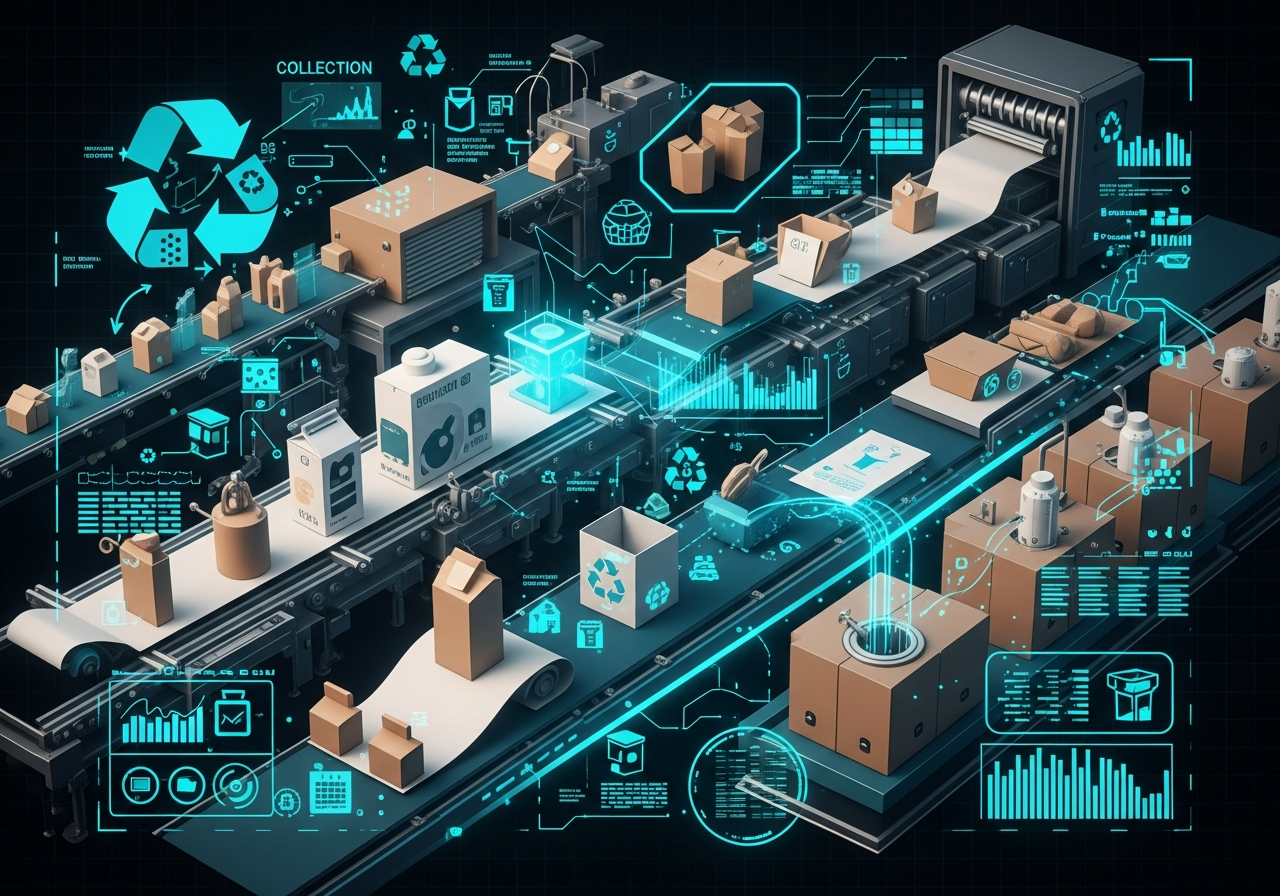
Paper mills and packaging converters share one material chain but run very different operations: continuous machines measured in reels on one side, short printing and converting runs measured in orders on the other. AI is useful where both face the same data problems: scheduling production, inspecting quality at line speed, tracing fiber and recycled content, and measuring circularity. ColdAI works on all four, from architecture review through build, deployment and managed operation1.
“”
In depth
Go deeper: guides for mills and converters
Working guides for mill engineers, production planners and compliance teams, each written around one decision you are likely to face.
- 01Deep divePaper machine web break predictionHow mills use QCS profiles, historian tags and web inspection events to predict paper machine web breaks and plan grade changes, with alerts crews trust.
- 02GuideTrim loss optimization in paper and board convertingHow trim optimizers cut parent reels and sheets into orders with less waste: cutting stock models, floor constraints, scheduling links and honest trim metrics.
- 03Regulation explainerEU PPWR compliance for packaging makersWhat Regulation (EU) 2025/40 asks of packaging manufacturers, importers and distributors, which duties apply now, which come later, and the data to keep.
Smart Packaging & Paper Manufacturing
The packaging and paper industry is being reshaped by sustainability mandates, e-commerce growth, and smart packaging technologies. Consumers and regulators demand recyclable and biodegradable materials, while brands want packaging that tells a story and connects digitally. ColdAI builds the AI and automation platforms that optimize production, reduce waste, enable sustainable materials, and create intelligent packaging experiences.
Use Cases We Deliver
AI Quality Inspection
Computer vision systems for real-time detection of print defects, seal integrity issues, and dimensional variations across high-speed packaging lines.
Production Optimization
AI-driven scheduling, changeover optimization, and process parameter tuning that maximizes line efficiency and reduces material waste on converting equipment.
Sustainable Materials Analytics
ML-powered analysis of material properties, recyclability characteristics, and lifecycle impact to accelerate the transition to sustainable packaging solutions.
Smart Packaging Platforms
Connected packaging with NFC, QR codes, and digital watermarks that enable product authentication, consumer engagement, and supply chain traceability.
Demand Forecasting
AI-powered demand prediction across SKUs, customers, and regions that optimizes inventory levels and production scheduling for packaging converters.
Packaging Design AI
Generative design tools that optimize packaging geometry for material usage, shipping efficiency, and shelf appeal while meeting sustainability targets.
How We Help Across Packaging
| Segment | Challenge | ColdAI Solution |
|---|---|---|
| Flexible Packaging | Print quality and seal integrity | Vision inspection, color management, seal testing |
| Corrugated | Board quality and conversion efficiency | Process optimization, defect detection, scheduling |
| Labels & Tags | Registration accuracy and die-cutting | Vision alignment, quality inspection, waste reduction |
| Paper & Pulp | Fiber optimization and energy costs | Process control, energy management, quality prediction |
Our Packaging Technology Delivery Process
Line Assessment & Data Mapping
Evaluate production lines, quality systems, and data infrastructure to identify AI deployment opportunities across converting operations.
Vision & Sensor Integration
Deploy camera systems, sensors, and edge computing hardware optimized for the specific packaging format and line speed.
Model Training & Validation
Train quality inspection and optimization models on production data with rigorous testing against diverse product specifications.
Production Line Deployment
Deploy to active production lines with operator training, MES integration, and continuous model improvement using production feedback.
Why Packaging Companies Choose ColdAI
- Quality inspection AI that operates at production line speed across diverse packaging substrates and formats.
- Sustainability analytics that help companies meet recycled content targets and EPR compliance requirements.
- Smart packaging platforms that bridge physical products and digital experiences.
- Production optimization that demonstrably reduces waste and improves overall equipment effectiveness.
One data foundation under four packaging and paper problems
Scheduling, inspection, traceability and circularity look like separate projects, but they draw on the same plant and business records. Building the lower layers once lets each later use case reuse the work of the first.
- Decisions and alerts
Schedules, inspection verdicts, traceability statements and circularity reports that people act on.
- Models and optimizers
Forecasting, vision, anomaly detection and optimization models, each with an owner and a test set.
- Contextualized records
Orders, specifications, lots, reels and pallets linked to sites, lines and machines in one hierarchy.
- Plant and business systems
DCS, historian, QCS, cameras, MES, ERP, laboratory systems and supplier portals.
Production scheduling from mill reel to converted pack
A mill plans in grade campaigns: long runs of one grade, sequenced to limit difficult transitions and matched to the deckle of the machine. A converter plans in orders: short runs on corrugators, printing presses, die-cutters and folder-gluers, where each changeover means new plates, inks, dies or board. The mill wants stability and the converter wants flexibility, and when both sit in one group the friction shows up as excess reel stock at one end and rush orders at the other.
Three kinds of model help. Demand sensing on the converter side, built from order intake and customer forecasts, gives the mill an earlier view of the reels it will need; ColdAI's practice lists converter-side demand sensing tied back to mill planning as a focus area1. Learned run-time and changeover-time estimates make schedules realistic rather than optimistic. Sequencing optimizers then order jobs to reduce changeovers, for example running light to dark inks on a flexographic press or grouping jobs that share a die.
Cutting reels into orders is a problem of its own, covered in the trim loss optimization guide, and transitions on the paper machine itself are covered in web break and grade-change prediction.
Quality inspection needs by substrate and process
Vision inspection is not one product. What counts as a defect, how it is sensed and what a model adds all change with the process.
| Process | Defects that matter | How they are sensed | What AI adds |
|---|---|---|---|
| Paper and board machines | Holes, spots, wrinkles, streaks, edge cracks | Full-width web inspection cameras and QCS scanners | Classifies defect types and links them to upstream process causes |
| Corrugating | Warp, delamination, crushed flutes, score cracks | Line-scan cameras, laser profiling, board moisture sensors | Spots warp trends early enough to adjust steam and glue |
| Flexible packaging print and lamination | Misregistration, color drift, missing print, gels, weak seals | Print inspection cameras, inline spectral color measurement, seal checks | Separates cosmetic from functional defects and reduces false rejects |
| Folding cartons and labels | Die-cut and crease errors, wrong artwork version, unreadable codes | Cameras at die-cutters and folder-gluers, code verifiers | Checks artwork and code content against the job record, not only image quality |
Inspection models need re-validation when substrates, inks or artwork change; plan that work into the change process rather than discovering it on the line.
Tracing fiber, resin and recycled content through the chain
Most traceability questions in this sector come down to proving where material came from and what share of it was recycled. Chain-of-custody schemes such as FSC and PEFC let mills and converters make certified claims either by physically separating material or by accounting methods that track certified and recycled inputs against outputs over a period. Recovered paper is traded by grade, commonly using the European list of standard grades in EN 643, and its quality varies from bale to bale.
For plastics, recycled content in packaging must be calculated and verified under a methodology the Commission sets by implementing act3, which pushes converters toward lot-level records rather than annual averages. Pulp and paper also fall under the EU deforestation regulation, Regulation (EU) 2023/1115, which covers products of Chapters 47 and 48 of the Combined Nomenclature except bamboo-based and recovered products2.
AI helps with the unglamorous parts: reading certificates and supplier declarations, reconciling inputs and outputs by lot, and flagging claims that exceed what the records support. ColdAI's practice lists recycled-content tracking and chain of custody for fiber and resin among its focus areas1. Where several companies must trust the same record, an anchor on a public ledger can show that it has not changed since it was written, while the data itself stays private.
What a credible circularity dataset records
Circularity claims face customers, auditors and regulators. Analytics only help if the records beneath them would survive a question about any single number.
Choosing a first AI project in a mill or converting plant
- If
Customer complaints or high reject rates on one line dominate the conversation
ThenStart with vision inspection on that line, with an agreed definition of a reject.
The data is local and the line crew sees the effect quickly.
- If
Sheet breaks or unstable grade changes cost the most machine time
ThenStart with break and transition analytics on historian data you already hold.
It needs labelled events rather than new hardware.
- If
Trim, changeovers or late orders are the main losses
ThenStart with scheduling and trim optimization on one machine or corrugator.
It uses existing ERP and MES data and can be tested by replaying past weeks.
- If
Customer and regulatory data requests keep piling up
ThenStart with a packaging specification and evidence data model.
Every later compliance or circularity report depends on it.
Working inside plant networks and OT security constraints
Most mill and converter data lives on operational networks that were never designed for cloud analytics. Models should read from historian replicas or a plant data layer in a demilitarized zone, following the zone and conduit principles of ISA/IEC 624434, and anything that writes back to control systems should pass through management of change. Line-speed vision usually runs on edge hardware beside the camera, with only results and samples leaving the line; see edge AI and IoT.
ColdAI's delivery approach for packaging starts with a line assessment and data mapping, adds camera and sensor integration where needed, trains and validates models on production data, and deploys them with operator training and MES integration1. The same team can then run the system under a managed service if you prefer not to operate it in-house.
Frequently asked questions
Where does AI usually help first in a paper mill compared with a converting plant?
In mills, strong early cases tend to sit on the paper machine: break and grade-change analytics, quality soft sensors and energy use, because the historian already holds long records. In converting plants, inspection and scheduling usually come first, because losses are spread across many short runs and changeovers. Either way, pick one machine or line, define the loss precisely and measure it before building anything.
Do we need new sensors before starting AI on a packaging line?
Often not. Historians, QCS scanners, MES records and existing inspection cameras usually hold enough to start, and the first step is mapping what is recorded and how reliably. New sensors make sense when a specific defect or loss is invisible in current data, such as seal integrity on a fast form-fill-seal line or board moisture at the corrugator double backer.
Can vision models cope with frequent artwork and substrate changes?
Yes, if the system is designed for change. Checks that compare print against the approved artwork file adapt to new jobs automatically, while models that learn what a defect looks like need re-validation when substrate, ink or finish changes. Build a small labelled sample for each new material family into the change process, and track false rejects per job to spot drift.
How does AI help mills cope with variable recycled fiber?
Recovered fiber varies in contaminants, ash, fiber length and stickies, and that variation shows up as wet-end instability, breaks and quality drift. Models can link bale or supplier attributes to machine behavior, recommend chemistry or blend adjustments, and give purchasing evidence about which grades and suppliers cost the mill most in lost stability.
Is production data safe if models run outside the plant?
It can be, and not every model needs to leave the site. Line-speed inspection typically runs on edge hardware in the plant, while scheduling and analytics can run in a private cloud or on-premises. Wherever they run, keep control networks segmented, give models read-only access through a replica, and agree what data may leave the site before the project starts.
What does a first engagement with ColdAI look like for a packaging company?
It usually starts with an assessment of one line or machine and a map of the data available, followed by a scoped pilot on one use case with success measures agreed in advance. If the pilot works, deployment adds operator training and MES integration, and the system can then be run by your team or under a ColdAI managed service1.
Sources
- Packaging & Paper: focus areas, use cases and delivery approach — ColdAI
- Regulation (EU) 2023/1115 on deforestation-free products, Annex I — EUR-Lex, Publications Office of the European Union
- Regulation (EU) 2025/40 on packaging and packaging waste, Article 7 — EUR-Lex, Publications Office of the European Union
- ISA/IEC 62443 Series of Standards — International Society of Automation
Latest analysis from this industry
Packaging & Paper Mills Are Tokenizing Waste Streams Before Carbon Credits. Here’s what changed
Forward-looking operators are deploying distributed ledgers to authenticate material provenance and waste-to-value chains, capturing margin before regulatory mandates arrive.
Your Packaging & Paper Line Speed Matters Less Than Agent Handoff Latency — here’s why
Production optimization now hinges on how fast autonomous systems transfer context between scheduling, quality, and material tracking—not throughput alone.