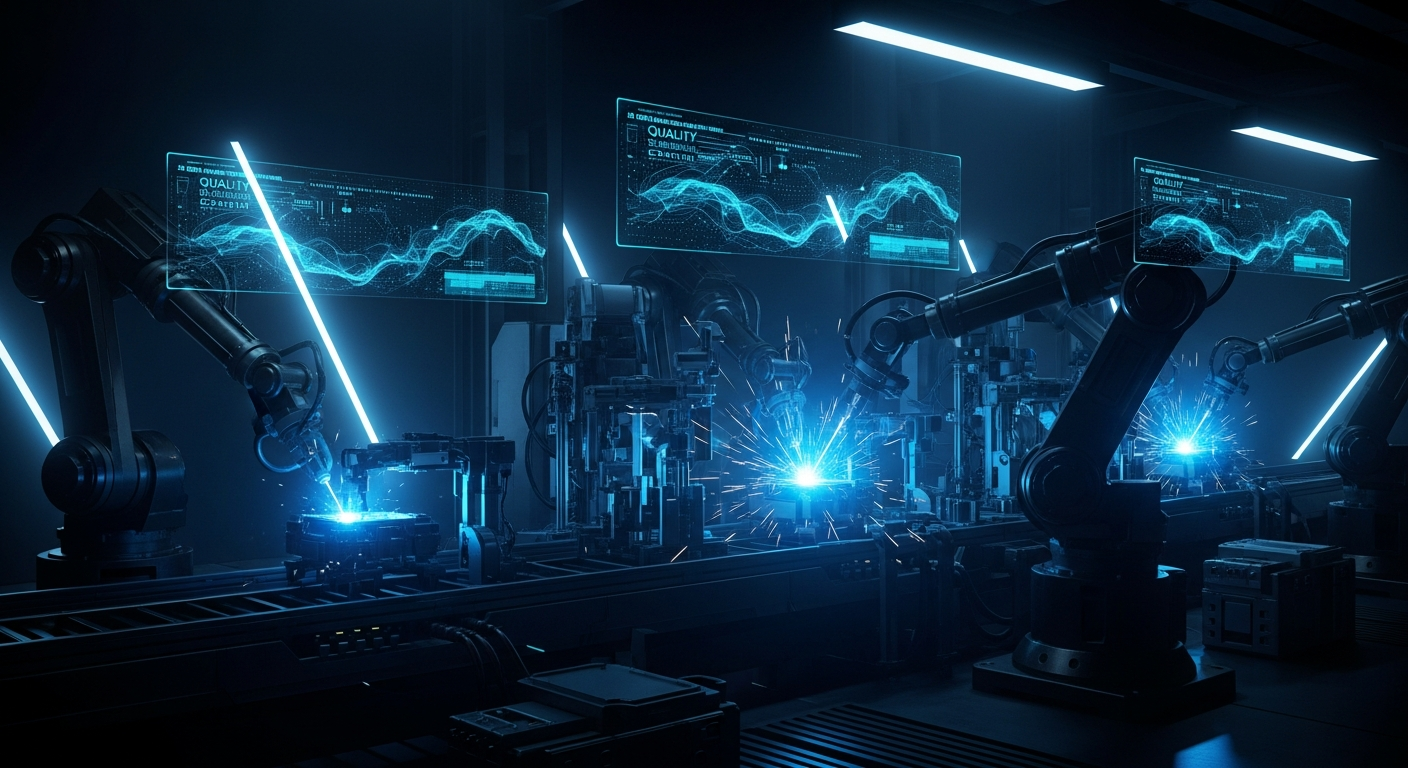
Industrials
Updated
Edge + Cloud
Predictive maintenance running on factory-floor edge with cloud aggregation
Digital twin
Per-line digital twin for throughput optimisation and changeover
OEE +15-25%
Typical overall-equipment-effectiveness uplift, ColdAI internal benchmark, 2026
What does ColdAI do for Industrials?
Industrial AI earns its keep when a prediction reaches someone who can act on it before the shift ends. ColdAI builds vision inspection, predictive maintenance, digital twin factories, supply chain visibility, robotics coordination and OEE analysis for discrete and process manufacturers, warehouses and heavy-equipment operators. Inference runs at the edge beside the machine, and every output lands in the MES, ERP, SCADA or maintenance system people already use.
“Predictive maintenance only delivers OEE uplift when the action loop reaches the maintenance team in minutes. Edge inference is what makes that loop close.”
In depth
Go deeper into industrial AI
Three method pages for plant teams: tracing OEE losses to their causes, scoring assets for predictive maintenance, and structuring shop-floor data so models can reach it.
- 01GuideOEE loss analysis with AI: from stops to root causeHow to automate OEE root cause analysis: capture machine states from PLCs, repair reason codes with operator-confirmed ML and turn loss Paretos into fixes.
- 02ChecklistPredictive maintenance readiness checklist for plantsA scored checklist for plant reliability teams: assets, failure modes, sensing, CMMS history, data paths and who acts on alerts, before you fund PdM.
- 03ArchitectureShop-floor data architecture: ISA-95, OPC UA and UNSA reference architecture for getting machine, MES and ERP data to analytics and AI: ISA-95 levels, OPC UA versus MQTT Sparkplug B and the unified namespace.
Industry 4.0 — From Concept to Production Floor
The industrial sector is being transformed by the convergence of AI, robotics, IoT sensors, and digital twins. The factories and facilities that win are those that can predict machine failures before they happen, detect quality defects in real-time, and reconfigure production lines autonomously in response to demand shifts. ColdAI delivers the full Industry 4.0 stack — from sensor integration and edge computing to enterprise-wide production intelligence platforms.
Use Cases We Deliver
Computer Vision Quality Inspection
Camera arrays and ML models on production lines detecting surface defects, dimensional variations, and assembly errors at speeds impossible for human inspectors.
Predictive Maintenance
Vibration, thermal, acoustic, and electrical sensors feeding ML models that detect early-stage equipment degradation and schedule maintenance in optimal windows.
Digital Twin Factories
Virtual replicas of entire facilities for simulating layout changes, new product introductions, and process modifications before touching the physical floor.
Supply Chain Visibility
End-to-end supply chain tracking from raw materials through finished goods distribution with AI demand forecasting incorporating seasonality and economic indicators.
Autonomous Robotics Coordination
Multi-robot orchestration for material handling, palletizing, and assembly tasks with dynamic path planning and workload sharing.
OEE Optimization Platform
Overall Equipment Effectiveness tracking with AI-driven root cause analysis automatically identifying drivers of availability, performance, and quality losses.
How We Help Across Industrial Sectors
| Segment | Challenge | ColdAI Solution |
|---|---|---|
| Discrete Manufacturing | Quality and throughput optimization | Vision inspection, predictive maintenance, OEE optimization |
| Process Manufacturing | Yield and energy efficiency | Process optimization, energy management, recipe tuning |
| Warehouse & Distribution | Labor efficiency and accuracy | Robotic automation, inventory optimization, pick path planning |
| Heavy Equipment | Asset utilization and maintenance | Telematics analytics, predictive maintenance, fleet management |
Our Industry 4.0 Delivery Process
Factory Assessment
Audit existing manufacturing equipment, control systems, and data infrastructure to identify the highest-value AI deployment opportunities.
Sensor & Edge Infrastructure
Deploy sensors, edge computing hardware, and data pipelines that capture the high-frequency data needed for AI-driven optimization.
Pilot Line Deployment
Deploy AI solutions on selected production lines with parallel monitoring to validate quality, maintenance, and efficiency improvements.
Plant-Wide Rollout
Expand successful pilots across the facility with operator training, MES integration, and centralized monitoring dashboards.
Why Industrial Companies Choose ColdAI
- Edge AI solutions that operate on the factory floor with millisecond latency, even without cloud connectivity.
- Computer vision systems trained on industrial imaging data — metals, plastics, textiles, electronics, and composite materials.
- Digital twin platforms that integrate with existing MES, ERP, and SCADA systems without requiring full infrastructure replacement.
- Measurable ROI: predictive maintenance alone typically reduces unplanned downtime by 30-50%.
Six industrial AI workloads by input, inference location and owner
The workloads share sensors and data plumbing, but differ in how fast they must answer and who receives the answer. Plan each one around those two facts.
| Workload | Main inputs | Where inference usually runs | Who acts on the output |
|---|---|---|---|
| Vision inspection | Line cameras, lighting control, reject signals | At the edge, within the machine cycle | Reject gate, then quality engineers |
| Predictive maintenance | Vibration, temperature, current, CMMS history | Edge for detection, central for fleet trends | Reliability engineers and planners |
| Digital twin factory | Layouts, cycle times, routings, live states | Central, for simulation and what-if runs | Industrial and process engineers |
| Supply chain visibility | ERP orders, supplier signals, inventory, logistics events | Central | Planners and buyers |
| Robotics coordination | Robot and AGV states, task queues, maps | Edge, close to the fleet controller | Fleet controller, with supervisors overseeing |
| OEE loss analysis | Machine states, counts, reason codes, context | Edge for state capture, central for analysis | Production and continuous improvement leads |
Inference location is a typical starting point, not a rule; connectivity, data volume and safety requirements decide each case.
The loop every plant AI output has to close
A model that detects something nobody acts on is overhead. Each workload above needs every step of this loop, including the last one, which keeps the model honest.
- Sense
Controllers, sensors and cameras produce signals with timestamps.
- Add context
Tie each signal to an asset, product, order and machine state.
- Infer
A model scores the situation where latency and connectivity allow.
- Decide
A rule or a named person decides what the score means for today's work.
- Act in the system of record
A work order, a hold, a schedule change or a reject, in MES, CMMS, WMS or ERP.
- Verify and relabel
Record what was actually found, which becomes the next training label.
Edge-first design and what still belongs in the cloud
ColdAI's industrial work runs inference on the factory floor so it keeps working when the wide-area link does not, with central aggregation for comparisons across lines and sites1. Four constraints usually force that choice: a reject decision has to land within the machine cycle, raw vibration and video are expensive to ship continuously, a plant cannot stop because a cloud region is unavailable, and some owners will not let process data leave the site.
Training, cross-site benchmarking, planning and simulation rarely share those constraints, so they can run centrally. The practical work is in the boundary: deciding which results travel upward, how models are updated at the edge without stopping lines, and how each edge device is patched and monitored. Model compression for constrained hardware is covered on our edge AI and IoT page.
Choosing a first project by type of operation
- If
You run discrete lines where scrap, rework or customer escapes dominate the losses.
ThenStart with vision inspection on the station that generates most escapes, with people reviewing every reject at first.
Inspection gives fast, countable feedback and a clear owner in quality.
- If
You run continuous or batch process lines where yield and energy drive cost.
ThenStart with condition monitoring of critical rotating equipment or with advisory recipe and setpoint guidance.
Unplanned stops and off-spec batches are expensive, and advisory modes leave control with operators.
- If
You operate warehouses or distribution centers.
ThenStart with slotting, pick-path and labor planning before robot fleet orchestration.
Planning gains need only WMS data, while robotics coordination depends on a stable task model first.
- If
You operate mobile heavy equipment across sites.
ThenStart with telematics-based condition monitoring and utilization analysis.
Machines already report engine and hydraulic data, so the first step is analysis rather than new hardware.
Vision inspection: decisions to settle before a camera is mounted
Most inspection projects that disappoint were decided at the bench, not in the model. Agree a defect catalog with quality, with limit samples for each class, and decide who owns it as products change. Control lighting and part presentation before tuning any network, because a model cannot recover detail the optics never captured.
Then decide the trade-off explicitly: a false reject costs a good part and an operator's trust, while an escape costs a customer complaint. Set thresholds per defect class with quality engineers, keep a human review lane for uncertain parts, and log every image the model rejects so the catalog grows. Formal qualification of inspection systems in vehicle production is covered under automotive and assembly.
Why industrial pilots stall between the first line and the tenth
A model tuned to one line
Early signalAccuracy drops on an identical line with different tag names or lighting.
MitigationStandardize data context at the edge and plan the second line from the start.
No owner in operations
Early signalThe pilot is run by a data team and alerts go to a dashboard.
MitigationName a production or maintenance owner before the pilot starts.
IT and OT disagree on who runs the edge
Early signalEdge devices miss patches or sit outside both teams' monitoring.
MitigationWrite down who patches, monitors and replaces edge hardware.
Success defined after the fact
Early signalThe pilot report lists anecdotes rather than an agreed measure.
MitigationFix the measure, baseline and comparison period before go-live.
Integration left to the end
Early signalOutputs are emailed or exported instead of creating work in MES or CMMS.
MitigationBuild the write path into the system of record as part of the pilot scope.
When AI becomes part of a machine: EU product rules
Most plant AI advises people or flags parts and does not perform safety functions. That boundary matters legally. Under Article 6(1) of the Artificial Intelligence Act, Regulation (EU) 2024/1689, an AI system is high-risk if it is a safety component of a product covered by the legislation in its Annex I, which includes EU machinery law, and that product requires third-party conformity assessment2.
The Machinery Regulation (EU) 2023/1230 lists safety components and embedded systems with fully or partially self-evolving behavior using machine learning that ensure safety functions among the categories needing third-party conformity assessment3. The Digital Omnibus on AI, Regulation (EU) 2026/1744, has since amended when AI Act obligations apply4. Keep safety functions on certified safety systems unless you intend to take on that regime, and confirm current dates and scope with counsel; this is not legal advice.
What a first plant conversation with ColdAI covers
Industrial engagements begin with an audit of equipment, control systems and data, move to sensors and edge infrastructure where gaps exist, prove results on a pilot line monitored alongside current practice, and only then extend across the plant with operator training and MES integration1. The method pages below go deeper into three recurring questions: why OEE losses happen, whether assets are ready for predictive maintenance, and how shop-floor data should be structured.
Where the question is broader than one plant, such as a network-wide operating model, the operations capability is the better starting point; where data must reach models across sites, see predictive monitoring and digital twins.
Frequently asked questions
Do we have to replace our MES or SCADA to add AI to a plant?
No. The usual pattern reads data from existing controllers, SCADA and historians through edge gateways, and writes results back into the MES, CMMS or ERP through their standard interfaces. Replacement is only worth discussing when a system cannot expose data or accept work at all, and that decision should be made on its own merits rather than as a side effect of an AI project.
Can industrial AI keep running when the plant loses its internet connection?
It should, for anything that affects production. Inspection, state capture and condition alerts run on edge hardware inside the plant and buffer results until the link returns. Central functions such as retraining, cross-site reporting and simulation pause during an outage without stopping the line. Design for this explicitly and test it before go-live by disconnecting the link.
How is AI for warehouses different from AI for production lines?
Warehouses are driven by orders, locations and labor rather than machine physics, so the core data comes from the WMS and the task stream rather than PLCs. Early value usually comes from slotting, pick-path planning and labor forecasting. Robot and AGV coordination follows once task data is reliable, and it adds safety and traffic-management questions that planning tools do not raise.
Does the EU AI Act apply to AI built into our machines?
It can. If an AI system acts as a safety component of machinery and that machinery needs third-party conformity assessment, the AI Act treats it as high-risk, and the Machinery Regulation adds its own requirements for machine-learning safety functions. Monitoring and advisory systems that do not perform safety functions usually fall outside that category, but check each case with counsel.
What should we prepare before a first conversation about a plant AI project?
A short description of the line or asset you care about, the loss or risk you want to reduce, what the control system and MES look like, what data is already historized and who would own the outcome in operations. Sample data helps but is not required at the first conversation; a clear problem and a named owner matter more.
Sources
- Industrials: Industry 4.0 delivery process and edge AI approach — ColdAI
- Regulation (EU) 2024/1689 (Artificial Intelligence Act), Article 6 and Annex I — EUR-Lex
- Regulation (EU) 2023/1230 on machinery, Annex I — EUR-Lex
- Regulation (EU) 2026/1744 amending Regulation (EU) 2024/1689 (Digital Omnibus on AI) — EUR-Lex
Latest analysis from this industry
How Discrete Manufacturers Are Tokenizing Machine Uptime Instead of Tracking It
Leading industrials are embedding distributed ledgers into production lines to create tradeable uptime guarantees, fundamentally restructuring OEM service contracts and working capital.
Behind the shift: The Best Industrials Plants Now Run Two Parallel Ledgers
Distributed manufacturing networks are deploying dual-ledger architectures to separate physical operations from financial settlement, unlocking real-time margin visibility.