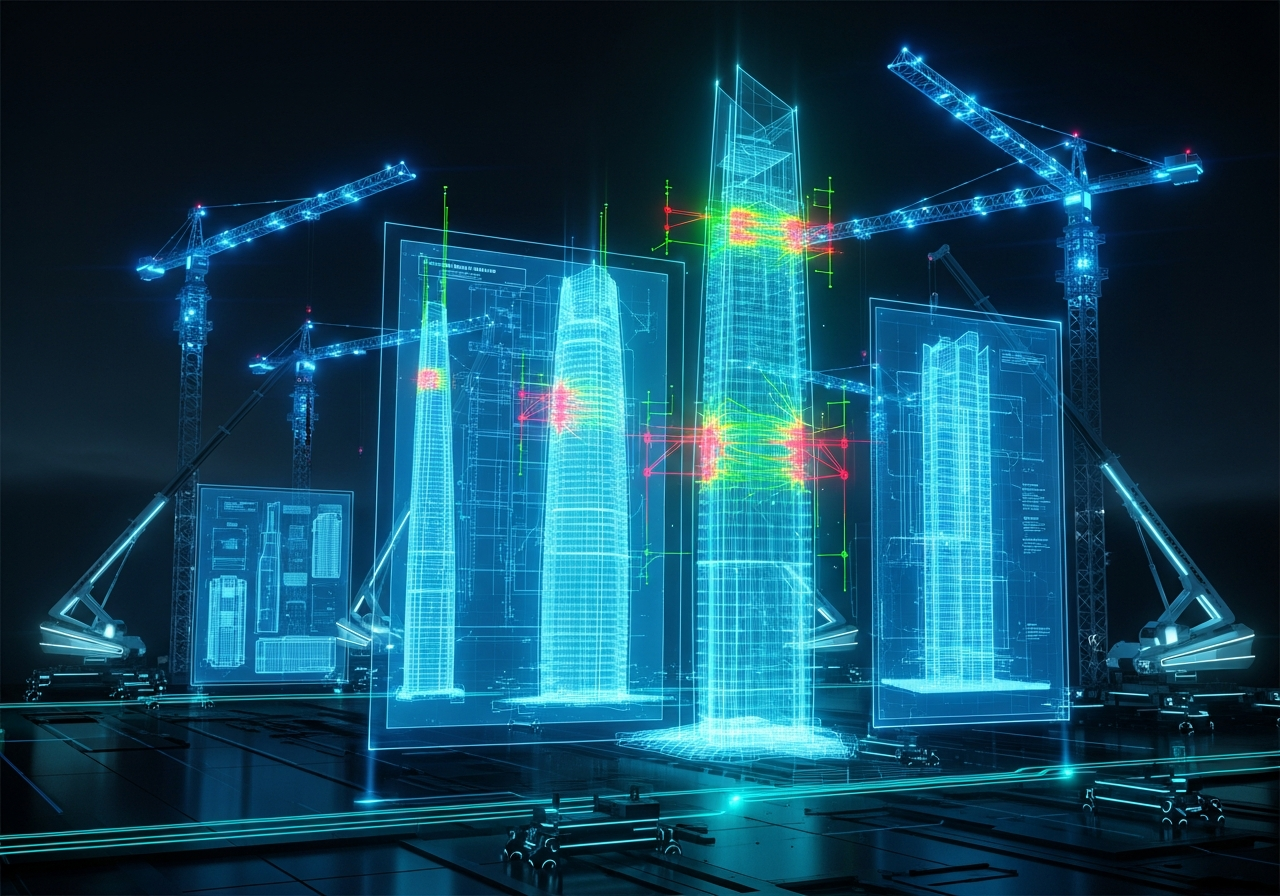
Engineering, Construction & Building Materials
Updated
BIM-native
All workflows operate against the building information model as source of truth
Computer vision
Site safety and progress monitoring via fixed and drone cameras
Predictive
Schedule and cost-overrun forecasting rather than reactive variance reporting
What does ColdAI do for Engineering, Construction & Building Materials?
AI in construction is most useful where a project already produces structured information and someone must make a decision from it: a model to check before an information exchange, site captures to compare with the schedule, cost and programme history to learn risk from, and handover records to complete. ColdAI designs and builds these systems for engineering, construction and building-materials firms across design, build and handover, starting from the BIM, scheduling and project management platforms already in use.
“Construction productivity has been flat for thirty years. AI on the BIM model — not on the spreadsheet — is the first technology that actually moves the number.”
In depth
Go deeper into construction AI
Method pages on information management, progress measurement and building safety records, written for BIM managers, project controls and duty holders.
- 01ProcessISO 19650 information management and AIWhere AI can safely assist ISO 19650 information management, from naming and metadata checks to clash triage, and which CDE approvals must stay with people.
- 02GuideAutomated construction progress monitoringHow automated construction progress monitoring compares site captures with the BIM model and schedule, where it is accurate and how far it supports payment.
- 03Regulation explainerBuilding Safety Act golden thread recordsWhat the Building Safety Act golden thread must hold for higher-risk buildings in England, from approval to handover, and how software supports duty holders.
Digitizing Engineering & Construction
Engineering and construction projects consistently suffer from cost overruns, schedule delays, and safety incidents — problems that stem from fragmented information, manual processes, and poor visibility across complex project ecosystems. AI, IoT, and digital twin technology are transforming how projects are designed, built, and managed. ColdAI deploys the technology that gives engineering and construction firms real-time intelligence across every phase of the project lifecycle.
Use Cases We Deliver
BIM-Integrated AI
AI systems that analyze Building Information Models to detect design conflicts, optimize material quantities, estimate costs, and simulate construction sequences before ground is broken.
Autonomous Site Monitoring
Drone and camera-based progress monitoring with AI-powered comparison against project schedules, detecting delays and deviations in real-time across construction sites.
Predictive Project Analytics
ML models that forecast cost overruns, schedule slippage, and resource bottlenecks by analyzing historical project data and real-time progress metrics.
Construction Safety AI
Computer vision systems that monitor PPE compliance, detect unsafe behaviors, and identify hazardous conditions on active construction sites.
Materials & Supply Chain Tracking
Blockchain-based materials provenance tracking and AI-optimized procurement that ensures quality, reduces waste, and prevents supply chain disruptions.
Digital Twin Buildings
Virtual replicas of buildings and infrastructure assets that simulate energy performance, structural behavior, and maintenance needs throughout the asset lifecycle.
How We Help Across Construction
| Segment | Challenge | ColdAI Solution |
|---|---|---|
| Commercial Buildings | Cost control and timeline management | BIM analytics, progress monitoring, predictive scheduling |
| Infrastructure | Safety and quality assurance | Safety AI, quality inspection, materials tracking |
| Industrial Facilities | Complex systems integration | Digital twins, commissioning optimization, MEP coordination |
| Residential | Scalability and defect prevention | Quality monitoring, schedule optimization, warranty analytics |
Our Construction Technology Delivery Process
Project & Site Assessment
Review project workflows, BIM maturity, site conditions, and technology infrastructure to define the AI deployment strategy.
Sensor & Data Infrastructure
Deploy cameras, drones, IoT sensors, and data pipelines that create a real-time digital view of construction progress and conditions.
Model Training & Integration
Train AI models on project-specific data and integrate with existing BIM, scheduling, and project management platforms.
Site Deployment & Monitoring
Deploy solutions to active construction sites with safety validation, user training, and continuous accuracy improvement.
Why Engineering & Construction Firms Choose ColdAI
- BIM integration expertise that connects AI insights directly to the design and construction workflow.
- Site monitoring solutions that work in harsh outdoor environments with dust, weather, and variable lighting conditions.
- Predictive analytics that have demonstrated measurable reductions in cost overruns across major infrastructure projects.
- Safety AI that combines computer vision with IoT sensors for comprehensive worksite safety monitoring.
Where AI changes construction decisions across design, build and handover
Construction projects are temporary organizations. A delivery team forms around one site, uses a mix of its members' tools and disbands at handover, so the data that would teach a model is scattered across firms and projects. That shapes where AI works. It works best on decisions that repeat within a single project, such as checking hundreds of model containers, classifying thousands of objects or comparing weekly captures with the programme, because the project generates enough examples to learn from and check against. It works least well where a firm hopes to learn from a handful of past projects recorded with different cost codes and schedules.
It also helps to be precise about technique. Rule-based checking tests models and documents against requirements that can be written down, such as exchange information requirements or a naming standard. Computer vision interprets site imagery for progress, quality and safety. Machine learning on cost, programme and risk registers estimates where a project is likely to slip. Language models read and draft the unstructured material that fills a project: requests for information, site diaries, specifications and change records. Most useful systems combine several of these, with a person accountable for each decision.
Construction AI applications by project stage and the data each needs
| Application | Main stage | Data it depends on | Decision people keep |
|---|---|---|---|
| Model checking and clash triage | Design and pre-construction | Federated models, exchange requirements, naming and classification standards | Approving information exchanges and resolving clashes |
| Quantity take-off and estimate support | Design and tender | Classified models, rate libraries, past tenders with consistent cost codes | Pricing, risk allowances and the tender figure |
| Schedule and cost risk forecasting | Construction | Programme updates, cost reports, change and risk registers | Recovery plans, contingency drawdown and client reporting |
| Progress monitoring from site captures | Construction | Registered captures, a model linked to schedule activities | Valuations, delay positions and resequencing |
| Safety monitoring | Construction | Camera feeds, site layout, permits and exclusion zones | Intervening on site and investigating incidents |
| Materials tracking and provenance | Procurement through installation | Delivery records, product declarations, batch and test certificates | Accepting materials and recording substitutions |
| Handover data and building digital twins | Commissioning and handover | As-built models, asset registers, operation and maintenance information | Accepting the asset information model |
A simplified map. Once a building is in use, operating and maintaining it is covered on our infrastructure page.
Where to start, by type of engineering or construction firm
- If
You are a main contractor running several live projects
ThenStart with progress monitoring and schedule risk on one project, using its own captures and programme updates.
A single active site produces enough data each week to test the approach and show whether reports change decisions.
- If
You are an engineering or design consultancy
ThenStart with automated model checking against exchange requirements and naming standards, then clash triage.
Your deliverable is information, and checking it is repetitive work with clear rules.
- If
You manufacture or supply building materials
ThenStart with structured product data and batch traceability that customers can import into their models and records.
Structured product data is what contractors need to populate models, handover records and golden thread evidence.
- If
You are a developer or client organization
ThenStart by writing information requirements that state what you need at each stage and at handover, then check deliveries against them.
Clients set the requirements every delivery team works to; vague requirements cannot be fixed by tools downstream.
- If
You are a specialist subcontractor, such as MEP or façades
ThenStart with installation tracking and quality records for your own packages, tied to the main contractor's model.
Your packages are where concealed work and hold points create the most disputes.
Project data to put in order before a construction AI pilot
Why construction AI stalls between the pilot project and the next one
Every project starts from zero
Early signalThe second project rebuilds rules, mappings and training data from scratch.
MitigationKeep rule sets, classifiers and data mappings as company assets, versioned and reused across projects.
The model and the site drift apart
Early signalAutomated results flag correct work as missing or deviations as complete.
MitigationFreeze model and programme versions for each reporting period and record which version each result used.
Site teams see monitoring as surveillance
Early signalCameras are covered, moved or ignored, and the workforce raises concerns.
MitigationConsult the workforce early, use safety imagery for site conditions rather than individual discipline and publish retention rules.
Forecasts built on too few projects
Early signalConfident overrun predictions that swing widely from month to month.
MitigationShow forecasts as ranges, combine them with planners' judgment and use project-level signals before cross-project history.
Results that cannot survive a dispute
Early signalReports nobody can trace back to the captures or records behind them.
MitigationKeep raw inputs unedited and dated, and log every automated result with its inputs and confidence.
How ColdAI works with engineering and construction firms
Our construction delivery process starts with a project and site assessment covering workflows, BIM maturity, site conditions and technology infrastructure. We then put the sensor and data infrastructure in place, train models on project-specific data and integrate them with existing BIM, scheduling and project management platforms, before deploying to live sites with safety validation, user training and continuing accuracy improvement1. Where the question is whether to invest at all, a consulting sprint assessment of two to four weeks can rate candidate use cases before anything is built2.
For records that several parties need to trust, such as materials provenance, change histories or golden thread evidence, we can anchor audit trails on Hedera Consensus Service, which ColdAI uses where proof of when and in what order something happened matters3. A ledger records evidence; it does not make the underlying information correct, so the people who approve the information stay accountable.
The in-depth pages below cover three areas where construction teams most often ask for a method: ISO 19650 information management, automated progress monitoring and the golden thread under the Building Safety Act. Operating and maintaining built assets such as bridges, roads, rail and water networks is covered on our infrastructure page, and building digital twins in more depth on our digital twins page.
Frequently asked questions
What is the best first AI project for a construction company?
Choose a decision that repeats often within one live project and has data you already collect. For contractors that is usually progress monitoring or schedule risk; for design consultants, automated model checking against exchange requirements. Avoid starting with cross-project forecasting unless your past projects share cost codes and programme structures, because the model will have too few comparable examples.
Do we need mature BIM processes before using AI in construction?
Not for every application. Document-heavy work such as reviewing requests for information, specifications and site diaries can start without a model. Progress monitoring, model checking and quantity work do depend on a model that is accurate, located and linked to schedule activities. Many firms improve their information management and add AI in the same program, one project at a time.
Can AI predict construction cost overruns and delays?
It can estimate the likelihood of slippage from programme updates, cost reports, change volumes and risk registers, and flag activities that resemble past problems. Predictions are uncertain, especially when trained on few projects, so present them as ranges alongside planners' judgment. The useful outcome is earlier attention to emerging problems, not a precise forecast.
Is computer vision for construction site safety legal under privacy law?
It can be, but site cameras capture identifiable workers and members of the public, so in the UK and EU data protection law applies. Carry out a data protection impact assessment, consult the workforce, limit retention, blur people where identity is not needed and define permitted uses in advance. Using footage for individual discipline needs particular care and clear policy.
How does AI support building handover and digital twins?
It checks asset information against the client's requirements, finds missing operation and maintenance data, matches equipment in the as-built model with commissioning records and flags inconsistencies before acceptance. A complete, verified asset information model is what makes a useful building digital twin possible; without it, the twin is a visual model with unreliable data behind it.
Sources
Latest analysis from this industry
How Tier-One Contractors Are Tokenizing Subcontractor Risk Instead of Insuring It
Distributed ledger rails are replacing traditional bonding and insurance underwriting for construction subcontractors, cutting working capital drag by twelve to nineteen percent.

Inside: Construction's Agent-First Firms Are Capturing 87% of Available Project Float
The competitive edge in 2026 construction isn't BIM adoption—it's deploying autonomous agents that reclaim schedule slack before it evaporates.