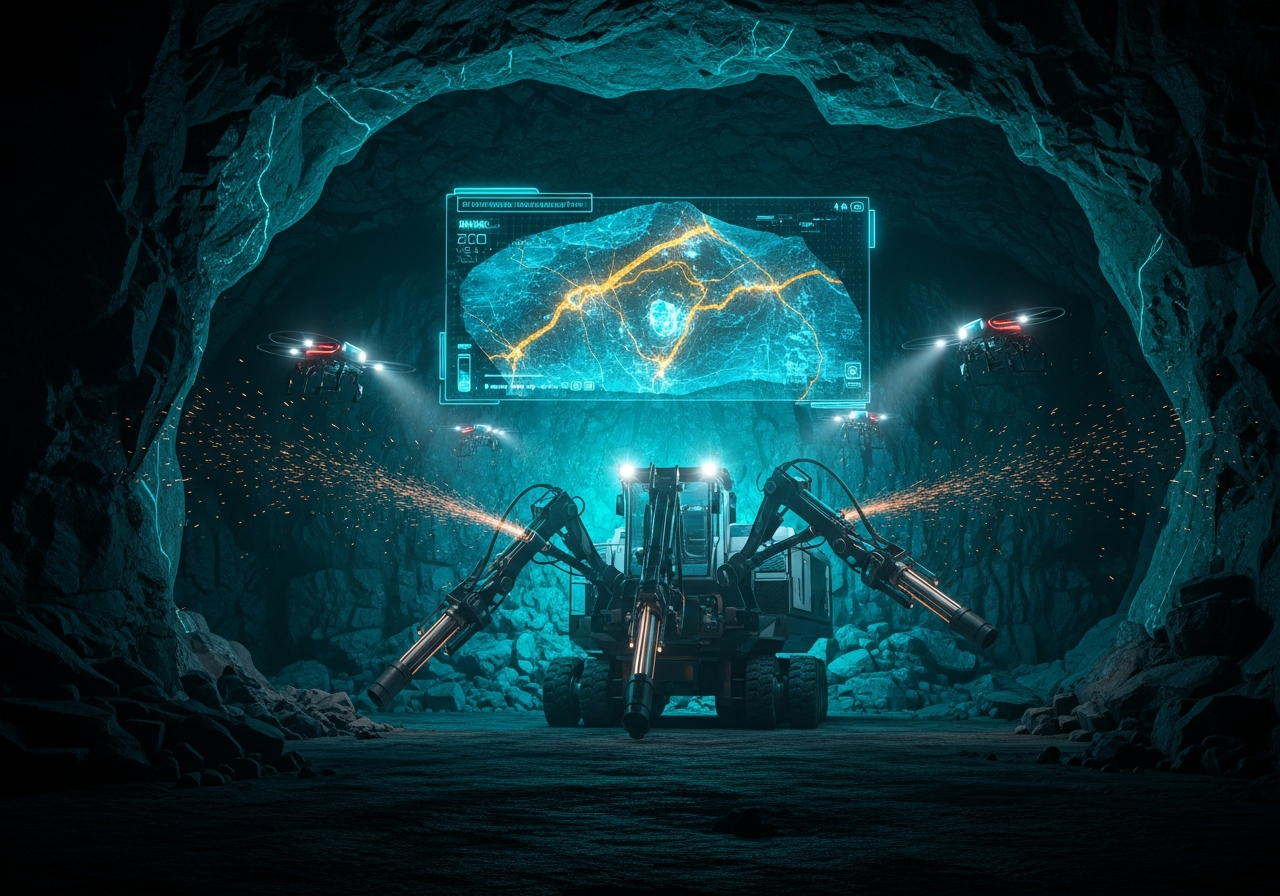
Metals & Mining
Updated
Autonomous
Fleet automation across haul trucks, drills, and processing
Geo + AI
Exploration and ore-body modelling with AI on geophysical data
Safety-first
Worker safety telemetry and predictive incident prevention
What does ColdAI do for Metals & Mining?
AI in mining depends less on any single model than on getting reliable data off machines, sensors and laboratories at sites where networks are patchy and conditions punish equipment. ColdAI designs and builds these systems for mines and processing plants: exploration analytics, fleet and equipment orchestration, predictive maintenance, and environmental and safety monitoring, each engineered to keep working when the link to head office drops.
“Autonomous haulage is the easy part. The hard part is integrating the autonomous fleet with the geological model so the entire mine plans itself.”
In depth
Go deeper into mining methods and standards
Three guides on exploration targeting, tailings surveillance and responsible-sourcing evidence, written for the geologists, engineers and compliance teams who do the work.
- 01Deep diveMachine learning for mineral prospectivity mappingHow machine-learning prospectivity models are built and validated: mineral systems proxies, method choice, spatial cross-validation and reporting limits.
- 02Regulation explainerTailings dam monitoring and GISTM conformanceWhat the Global Industry Standard on Tailings Management expects of monitoring, who acts on the data, and how analytics feed a trigger action response plan.
- 03GuideResponsible minerals traceability and due diligenceA guide to mineral supply chain due diligence: the OECD five steps, EU and industry regimes, chain-of-custody models and the records each node must keep.
AI for Metals & Mining Operations
Mining and metals operations face unique challenges — remote locations, hazardous conditions, volatile commodity prices, and increasing environmental scrutiny. AI is transforming the sector by enabling autonomous equipment, predictive maintenance, ore body modeling, and environmental monitoring that improves safety, reduces costs, and extends mine life. ColdAI builds the technology platforms that modernize mining operations from exploration through processing.
Use Cases We Deliver
AI Exploration Analytics
Machine learning models that analyze geological survey data, satellite imagery, and geochemical assays to identify high-probability mineral deposits and optimize exploration targeting.
Autonomous Equipment Orchestration
Fleet management for autonomous haul trucks, drilling rigs, and load-haul-dump equipment with AI-driven dispatch optimization and collision avoidance.
Predictive Equipment Maintenance
Condition monitoring for crushers, conveyors, mills, and heavy mobile equipment using vibration, temperature, and oil analysis data to prevent catastrophic failures.
Ore Grade Optimization
Real-time ore grade estimation and blending optimization that maximizes recovery rates and ensures consistent feed quality to processing plants.
Environmental Monitoring
Continuous monitoring of water quality, air emissions, tailings dam stability, and rehabilitation progress with AI-powered early warning systems.
Mine Safety Systems
AI-powered proximity detection, fatigue monitoring, atmospheric analysis, and emergency response systems for underground and open-pit mining operations.
How We Help Across Mining
| Segment | Challenge | ColdAI Solution |
|---|---|---|
| Open Pit Mining | Fleet optimization and grade control | Autonomous haulage, ore grade estimation, blast optimization |
| Underground Mining | Safety and ventilation management | Atmospheric monitoring, proximity detection, ground support analysis |
| Processing Plants | Recovery optimization and energy costs | Process optimization, grinding optimization, reagent management |
| Exploration | Target prioritization and drilling efficiency | Geological AI, drill targeting, resource estimation |
Our Mining Technology Delivery Process
Site Assessment & Data Audit
Evaluate mine operations, equipment fleet, sensor infrastructure, and data systems to identify the highest-impact AI opportunities.
Ruggedized System Design
Design solutions for the harsh conditions of mining environments — dust, vibration, extreme temperatures, and limited connectivity.
Pilot Site Deployment
Deploy AI systems on selected equipment or processes with safety validation and parallel monitoring against existing operations.
Fleet/Mine-Wide Expansion
Roll out validated solutions across the fleet or mine site with operator training, integration with dispatch systems, and continuous improvement.
Why Mining Companies Choose ColdAI
- AI systems designed for the harsh conditions and remote connectivity challenges of mining environments.
- Autonomous equipment platforms with proven reliability in 24/7 mining operations.
- Environmental monitoring systems that satisfy regulatory requirements and ESG reporting standards.
- Ore body modeling that improves resource estimation accuracy and mine planning decisions.
How data moves through a connected mine
Most mining AI problems are data-path problems first. The layers below show where information is produced, where it is used, and which layer has to keep working when the one above it is out of reach.
- Enterprise planning and ESG
Life-of-mine planning, corporate reporting and long-horizon models that can tolerate data arriving hours late.
- Remote operations centre
Dispatch oversight, process supervision and maintenance planning, often far from the pit or plant.
- Site data platform
Historian, fleet management system, laboratory information system and maintenance records held on site, with a buffered copy sent upstream.
- Edge compute at the asset
On-board or pit-side computers that run time-critical inference and store data through network outages.
- Machines, sensors and labs
Haul trucks, drills, crushers, mills, piezometers, gas monitors and assay results: the raw signal.
Deciding where a mining AI workload should run
| Criterion | On the machine or sensor | Site data centre | Remote centre or cloud |
|---|---|---|---|
| Survives a lost network link | Yes, and it must keep working through the outage | Yes for the site; upstream sync resumes later | No; decisions pause or fall back to site rules |
| Response time it can support | Sub-second warnings and local alarms | Seconds to minutes, such as reassigning a truck | Minutes to days, such as planning and reporting |
| Typical workloads | Proximity warnings, vibration screening, camera checks | Fleet dispatch, process soft sensors, grade reconciliation | Exploration models, fleet-wide maintenance analytics, ESG reporting |
| How models are updated | Signed packages installed in maintenance windows, with rollback | Scheduled releases tested against site data | Frequent releases evaluated centrally |
| Main constraint | Power, heat, dust, vibration and limited compute | Server-room conditions and local support skills | Bandwidth from site, latency and data-residency terms |
Many systems span all three columns: a vibration model screens on the machine, a site service checks the alert against open work orders, and a central model learns from every site.
Choosing a first AI use case on an operating mine
- If
Unplanned stoppages of a few critical assets, such as crushers, mills or conveyors, dominate lost production and condition data already exists.
ThenStart with condition monitoring on those assets, wired into the maintenance work-order system so every alert has an owner.
The data path from sensor to planner is short, so the value shows quickly.
- If
Haul cycle times vary widely between shifts and the fleet management system already logs every load and dump.
ThenStart with dispatch and queue analysis before changing anything about automation.
Cycle data is often among the cleanest records on a mine, and the findings shape later automation decisions.
- If
Plant recovery or throughput swings with ore type and a historian holds long runs of process tags.
ThenStart with an advisory soft sensor for operators and keep it advisory until it has run alongside the existing control strategy.
Control changes affect safety and product quality, so trust has to be earned in shadow mode.
- If
The pressing need is regulatory or community assurance on tailings, water or dust.
ThenStart with monitoring data quality and alerting, then add analytics, as described in tailings dam monitoring.
Monitoring evidence is defensible only if the underlying data is complete and reliably timestamped.
- If
The company is exploring and has no operating assets yet.
ThenStart by consolidating legacy data, then consider prospectivity modelling.
Historical drilling and survey data is the asset, and its condition decides what any model can do.
Safety-critical functions stay under engineered controls
Why mining AI pilots stall before site-wide use
Machine data locked inside OEM systems
Early signalThe pilot works on one manufacturer's fleet and cannot see the rest of the equipment.
MitigationSettle data-access terms during procurement and normalise data in a site layer rather than relying on per-vendor dashboards.
Connectivity assumed to be constant
Early signalModels fail or leave gaps when trucks enter dead zones or the satellite link degrades.
MitigationDesign for store-and-forward from the start and test the system with the network deliberately cut.
Ore and conditions change under the model
Early signalAccuracy drops as mining moves into a new domain, a new pit stage or a different season.
MitigationTrack input drift against the geological model and mine plan, and schedule retraining when the plan changes, not only after errors appear.
Nobody owns the alert on night shift
Early signalAlerts land on a dashboard that no one watches outside day hours.
MitigationRoute each alert type to a named role in the shift roster and review response times at shift handover.
Hardware not specified for the site
Early signalEdge devices fail from dust, heat or vibration within weeks of installation.
MitigationSpecify enclosures, power and mounting for each location, and hold spares on site.
Records to gather before scoping a mining AI project
What ColdAI builds for mines and processing plants
ColdAI's metals and mining work covers exploration analytics, orchestration of autonomous mining equipment, predictive maintenance for heavy machinery, and environmental and safety monitoring across open-pit and underground operations1. The common thread is the data path: getting trustworthy signals from the field to the people and models that act on them, and keeping that path working where conditions are hard on equipment and networks.
Delivery draws on the firm's engineering in edge AI and IoT, predictive monitoring and digital twins. Where customers, auditors or regulators need proof of when a reading or a custody record was created, the Hedera Consensus Service can serve as a verifiable, timestamped log for that audit evidence2. The guides below go further into three topics that each have their own methods and rules: exploration targeting, tailings surveillance and responsible-sourcing evidence.
Frequently asked questions
What problems does AI solve on a mine site?
The most common are unplanned equipment downtime, variable haul cycle times, unstable plant recovery, slow interpretation of exploration data, and the effort of keeping environmental and safety monitoring complete. In each case the model is only part of the work; most of the effort goes into getting clean, timestamped data from machines, sensors and laboratories to the people who act on it.
Can mining AI work without a reliable connection to head office?
Yes, if it is designed for that from the start. Time-critical inference runs on the machine or at the site, data is buffered locally during outages and forwarded when the link returns, and models are updated in planned windows with a rollback path. Central analytics then work on data that arrives late, rather than assuming a constant connection that remote sites rarely have.
Do we need autonomous haul trucks before AI is worthwhile?
No. Autonomy is one application, and many mines get value earlier from condition monitoring on fixed plant, dispatch analysis on a conventional fleet, or advisory models in the processing plant. Those projects also build the data foundations, such as fleet records, historian tags and maintenance history, that any later automation programme will depend on.
How does AI fit with existing OEM and fleet management systems?
It should sit alongside them, not replace them. Equipment suppliers' systems and the fleet management system remain the sources of record and, for safety functions, the certified control path. AI services read from them through agreed interfaces, combine data across vendors in a site data layer, and return recommendations or alerts to the tools operators and planners already use.
Is our historical mining data good enough to start?
Usually good enough to find out, which is the first step. Fleet records, historian tags and work orders often contain gaps, renamed assets and inconsistent failure codes, and assessing them against a specific use case shows what can be used now and what must be fixed. Waiting for perfect data tends to delay projects without improving the data.
Who should own a mining AI system once it is live?
A named operational role, not the project team. A maintenance model belongs to the maintenance superintendent or reliability engineer, a dispatch model to the mine control lead, a monitoring system to the engineer responsible for that facility. They decide how alerts are acted on, while a technical owner keeps the models, data feeds and edge devices working.
Sources
Latest analysis from this industry
Underground Mines Are Tokenizing Drill Data Before They Tokenize Ore. Here’s what changed
Distributed ledgers are unlocking more value from geological information rights than from mineral traceability, reversing conventional wisdom about blockchain in extractives.

Why Mining's Real AI Bottleneck Is Geological Certainty, Not Compute Power
Operators who treat subsurface data as a supervised learning problem are burning capital on models that fail at the first lithology surprise.
The case for: Metals & Mining Operations Are Abandoning Centralised AI for Agent Meshes
The shift from monolithic prediction models to decentralised agent networks is cutting unplanned downtime by 40% and rewriting capex allocation across the sector.