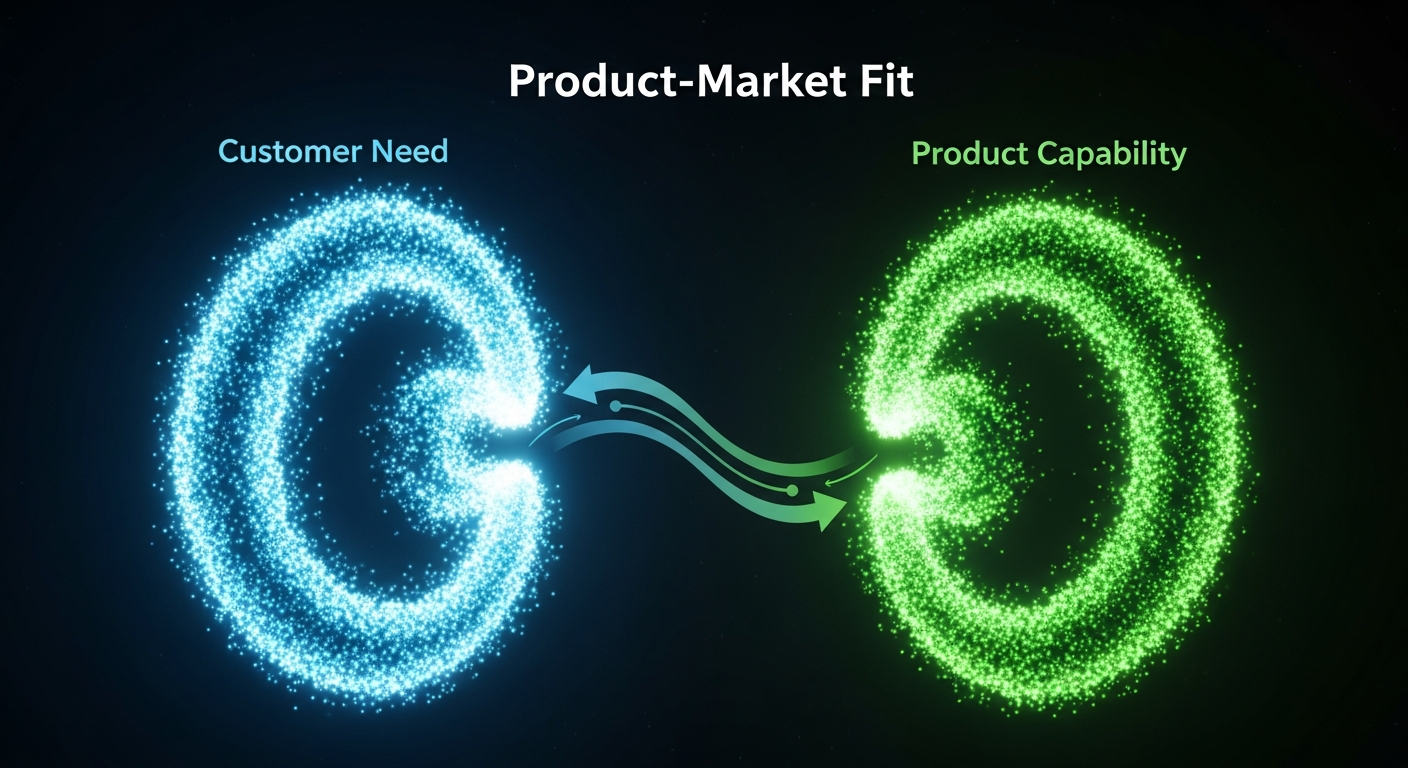
Corporate venture building works when the venture borrows the parent's few unfair advantages, such as data, distribution, licenses and brand, and keeps everything that sets the pace of a startup separate: its team, P&L, technology stack and decision rights. For an AI-native venture, the hardest part is drawing that line asset by asset, then agreeing in advance when the venture spins out or folds back.
Why the line has to be drawn asset by asset
Executives usually frame the choice as independence versus integration. The research suggests that framing is too coarse. A 2000 study in the Journal of Business Venturing by Stewart Thornhill and Raphael Amit surveyed 97 Canadian corporate ventures. They found that the degree of fit between parent and venture affected success, which they measured as meeting internal milestones on schedule. Success was associated with high levels of awareness, commitment and connection, and the relational side of the link (culture and structure) mattered more than the economic side.
A 2021 paper in the same journal by Matthias Waldkirch, Nadine Kammerlander and Conrad Wiedeler drew on 62 interviews from 43 corporate ventures. It concluded that involvement by the parent's dominant coalition, meaning its most influential leaders, can replace venture autonomy as a driver of innovation. Independence is therefore not the only route. What the venture needs is the right kind of contact with the right parts of the parent.
Charles O'Reilly and Michael Tushman, in a Harvard Business School working paper, describe the design that follows from this. The design that follows uses separate subunits, each with its own competencies, systems, incentives, processes and cultures, held together by a common strategic intent, shared values and targeted linking mechanisms that give the new unit access to shared assets. Targeted is the operative word. The working paper notes that without such linking mechanisms an exploratory unit cannot use the parent's capabilities.
What to take from the parent
Treat each borrowed asset as a loan with terms, not as a gift. Four assets matter most.
Data
Data is the asset most likely to make an AI-native venture viable, and the one most likely to create a legal problem. In the EU, Article 5(1)(b) of the General Data Protection Regulation says personal data must be collected for specified, explicit and legitimate purposes and not further processed in a manner incompatible with them. Article 6(4) sets out what a controller must weigh when judging compatibility: the link between the original and new purposes, the context of collection including the relationship with the person, the nature of the data, the possible consequences, and the safeguards in place.
A venture that trains a model on the parent's customer records is a new purpose in most cases. Before the venture's first sprint, have counsel assess each data source against that test, and record the decision. Where the answer is no, the options are consent, aggregation or synthetic data, or buying the data elsewhere. Non-personal data raises contract questions instead: what the customer agreements, supplier terms and data licenses actually allow.
Distribution
Access to the parent's customers is often the largest advantage, and the easiest to waste. A sales force that sells a mature product has quotas and relationships it will not risk on an unproven one. Negotiate access narrowly: a defined list of accounts, a named sponsor on each, and a rule that the venture owns the follow-up. Limit introductions to customers for whom the new offer is a real fit. Broad access invites a flood of poor-fit pilots that tell the venture nothing.
Licenses and intellectual property
List every license, patent, model and software component the venture will use, and check whether the parent may sublicense it to a separate entity. Field-of-use limits, change-of-control clauses and restrictions on training can be unpleasant surprises. NIST's AI Risk Management Framework asks organizations to have policies for AI risks tied to third parties, including infringement of a third party's intellectual property (GOVERN 6.1), and to monitor risks and benefits from third-party resources, including pre-trained models (MANAGE 3.1 and 3.2). A venture built on borrowed components inherits those obligations.
Brand
Lend the brand last and on terms that can be withdrawn. Early customers who buy because of the parent's name are telling you about the parent, not about the product. A revocable license, with the right to approve claims about safety, accuracy or compliance, protects the parent if the venture misfires. It also protects the venture from being judged on the parent's standards before it has found its own.
What to keep separate
Four things should sit outside the parent's normal operating machinery.
The team. Hire the core team into the venture, with its own role definitions, pay design and equity-like incentives where law and policy allow. Secondees who keep their parent reporting line will answer to the parent's priorities when the two conflict. A founder from inside the company is fine, as long as the person has real authority.
The P&L. Give the venture its own profit and loss statement, with transfer prices for anything borrowed. If the parent's data, sales time and cloud contracts are free, the venture's unit economics will look better than they are, and the decision to scale will rest on numbers that cannot be reproduced after a spin-out. For AI-native ventures, include inference and evaluation costs per transaction from the start.
The technology stack. Keep the venture's code, models, evaluation sets and deployment pipeline outside the parent's enterprise platform, with defined interfaces for the data it is allowed to receive. Parent change-control cycles and architecture review boards are designed for stability. A venture iterating on model behavior weekly cannot work under them. A separate stack also makes spin-out or sale a matter of transferring assets and not of untangling them.
Decision rights. List the decisions the venture's leader makes alone, such as hiring, product scope, pricing within a band and vendor choice, and the ones reserved to a venture board. This is where most ventures lose their independence, one approval at a time.
Governance and stage gates
The governance question is who can say yes, who can say no, and who can say stop. A workable venture board has three to five people: one parent executive who has real budget authority, one who represents the core business whose customers or data the venture touches, an independent or outside member, and the venture leader as a non-voting member. The gates themselves, and their evidence, are a matter for a separate checklist. What matters here is how the board behaves.
Thornhill and Amit found that ventures lessened their economic ties to their parents as they matured, while relational bonds stayed largely intact. They also found an increasing emphasis on financial targets and decreasing CEO involvement over time. That points to a pattern: senior air cover early, financial accountability later. Plan the board's attention that way. Early meetings focus on removing blockers the parent has created. Later meetings focus on unit economics and the cost of continued support.
Three more rules keep the board effective. Decisions are made at gates, not in the corridor, and the minutes record the evidence used. The board reviews the borrowed-asset ledger at every meeting: which data, accounts and licenses the venture is using, on what terms. And the board must be able to stop the venture without it being treated as a personal failure for the sponsor. AI governance sits within this: NIST's framework calls for post-deployment monitoring that includes override and decommissioning (MANAGE 4.1), and for executive leadership to take responsibility for decisions about AI risk (GOVERN 2.3). Make a named board member responsible for those checks.
When to spin out and when to fold back
The most useful framing comes from the O'Reilly and Tushman paper, which draws on earlier work by Robert Burgelman. It sorts new opportunities along two questions: how strategically important is the opportunity, and can it use the parent's existing assets such as sales channels, manufacturing or a common technology platform?
- Unimportant strategically and unable to use the parent's assets: there is no reason to pursue it inside the company. Spin it out.
- Unimportant strategically but able to use existing assets: internalize it or contract it out.
- Important strategically but unable to use the parent's assets: run it as an independent business unit. The working paper cites product substitution, where a new technology replaces the old, as a typical case.
- Important strategically and able to use the parent's assets: this is where an ambidextrous design fits best. Spinning the unit out would, in the authors' words, sacrifice the future or at least waste available resources.
The paper also reports a study by Tushman and colleagues of 22 innovation attempts across 13 companies. Ambidextrous designs outperformed functional, cross-functional and spin-out designs, and the only case in which a simpler design did better was product substitution. This is a single study summarized in a working paper, so treat it as evidence for a hypothesis, not a rule.
Christensen and Bower's view, quoted in the same paper, adds a counterweight: a separate organization is necessary when the new technology has a lower profit margin than the mainstream business and must serve a new set of customers. If your venture will cannibalize a high-margin line, expect resistance from the core and plan to separate it more fully.
Agree the triggers when you approve the venture, not when it is succeeding. Useful pre-agreed triggers include: the venture's economics hold without free parent inputs; more than a stated share of its revenue comes from customers outside the parent's base; outside investors would value the venture above the parent's carrying cost; or the parent's own data constraints make the venture's product impossible to deliver. Fold-back triggers mirror them: the venture depends on the parent's customers for nearly all revenue, its technology is converging with a core product, or its market has not formed by the final gate. A decision to fold back is a decision to keep the learning. Write down who takes the team, the stack and the data when it happens.
Where to start
- Build the borrowed-asset ledger. List every asset the venture would take from the parent and give each a type (data, distribution, license, brand, people, infrastructure), an owner, a term, a price and a legal check. Anything without a legal check does not go in.
- Run the data test. For each data source, document the original purpose and the compatibility assessment for the venture's purpose. Park the sources that fail.
- Write the decision-rights list, in two columns: the venture leader decides, the board decides. Have the chief executive sign it.
- Set the P&L rules, including transfer prices and the cost of inference and evaluation, so the first financial review is realistic.
- Pre-agree the spin-out and fold-back triggers, and name who owns the team and technology in each case.
Begin with the ledger and the decision-rights list, because they surface the disagreements that would otherwise appear later, at higher cost.
References
- O'Reilly and Tushman, Harvard Business School Working Paper 07-088: Ambidexterity as a Dynamic Capability: Resolving the Innovator's Dilemma
- Thornhill and Amit, Journal of Business Venturing 16 (2000): A Dynamic Perspective of Internal Fit in Corporate Venturing
- Waldkirch, Kammerlander and Wiedeler, Journal of Business Venturing 36(5) (2021): Configurations for corporate venture innovation: Investigating the role of the dominant coalition
- Regulation (EU) 2016/679 (GDPR), Article 5: Principles relating to processing of personal data
- Regulation (EU) 2016/679 (GDPR), Article 6: Lawfulness of processing
- NIST: Artificial Intelligence Risk Management Framework (AI RMF 1.0), NIST AI 100-1