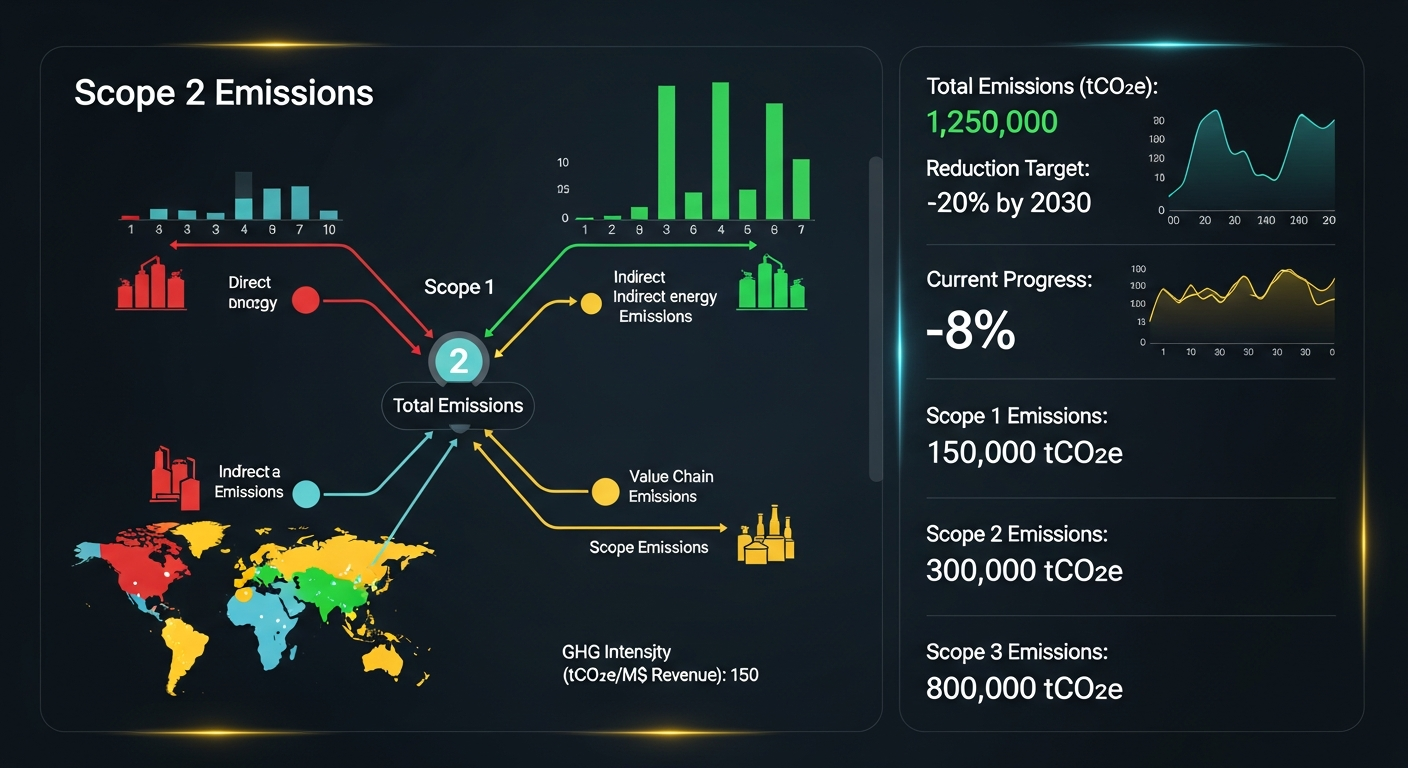
AI energy consumption becomes a corporate climate issue through accounting rules: electricity you buy and consume is Scope 2, and the compute you rent from cloud and model providers is usually Scope 3. The International Energy Agency expects data center electricity use to more than double to about 945 TWh by 2030, so your emissions inventory, targets and supplier contracts need AI-specific questions.
What the IEA numbers mean for a corporate buyer
The International Energy Agency's 2025 report Energy and AI is the most cited baseline. It estimates that data centers used around 1.5% of global electricity in 2024, or 415 TWh. The United States accounted for 45% of that consumption, China for 25% and Europe for 15%. Consumption has grown by around 12% per year since 2017, more than four times faster than total electricity consumption.
Looking ahead, the IEA projects that data center electricity consumption more than doubles to around 945 TWh by 2030, and it names AI as the most important driver. It also puts that growth in proportion: data centers account for around one-tenth of global electricity demand growth to 2030. Emissions from data center electricity use rise from 180 million tonnes today to 300 million tonnes by 2035 in its Base Case, and up to 500 million tonnes in its Lift-Off Case, which stays below 1.5% of energy sector emissions.
Two points follow for a company that buys AI. First, the aggregate share is modest, but the growth rate and the geographic concentration are not. The IEA notes that AI-focused data centers can draw as much electricity as power-intensive factories, and are far more concentrated in particular places. Second, the IEA treats its figures as projections with uncertainty about adoption, efficiency gains and energy-sector bottlenecks, which is why it publishes several cases. Use them as ranges, not as a forecast for your own footprint.
Where AI electricity lands in your inventory
The GHG Protocol's corporate scopes decide which AI energy you report. The GHG Protocol's Scope 2 Guidance covers emissions from purchased or acquired electricity, steam, heat and cooling. If you run GPU servers in your own facility or in space you control, the electricity is yours and the emissions are Scope 2.
If you rent capacity from a cloud provider or call a hosted model through an API, the provider buys and consumes that electricity. In our reading of the scope definitions, your share is not your Scope 2. It sits in Scope 3, most often in category 1, purchased goods and services. The 2020 Guidance for ICT Companies Setting Science Based Targets, developed by the ITU, GeSI, GSMA and the Science Based Targets initiative, names purchased goods and services and use of sold products as the most significant Scope 3 categories for an ICT company.
The boundary matters because it changes what you can control and what you can measure. Scope 2 can be managed through your own procurement. Scope 3 depends on what your supplier discloses and how it allocates a shared fleet to your workloads, which is why the supplier questions later in this article carry most of the weight.
Location-based and market-based reporting
The GHG Protocol Scope 2 Guidance, published in 2015, requires dual reporting. A location-based figure uses average emission factors for the grid where the electricity is consumed. A market-based figure reflects the contractual instruments you bought, such as renewable energy certificates or power purchase agreements, with a residual mix factor applied to the rest.
For AI workloads the two numbers can diverge sharply. Compute is concentrated in a few grids, so the location-based figure depends heavily on where the servers sit. A buyer that matches annual consumption with certificates from a different region can report a low market-based figure while the physical grid supplying the servers is carbon-intensive. The GHG Protocol's revision overview describes the issue: under current rules a building can match night-time consumption with daytime certificates from generators in another state, because annual matching and broad market boundaries are permitted.
Report both numbers and explain the gap. Do not publish only the lower one, because disclosure regimes treat them differently. The overview notes that ESRS requires both location-based and market-based reporting, while IFRS requires only location-based.
The Scope 2 revision, as of November 2026
The GHG Protocol ran a public consultation on revisions to the Scope 2 Guidance from 20 October 2025 to 31 January 2026, after extending the original deadline. The proposals were published for comment and are not yet final rules.
According to the GHG Protocol's overview of the proposed revisions, the draft would keep dual reporting. For the market-based method, it proposes hourly matching of contractual instruments with deliverability to the grid that serves the load. It would also change the location-based method to use the most precise emission factor accessible, with spatial precision first and then temporal precision. Where no residual mix exists, the draft would remove the option of falling back on grid-average factors. It proposes load profiles to approximate hourly data, exemptions from hourly matching for smaller reporters, and a multiyear phased implementation.
On timing, the October 2025 announcement said final publication of the new Scope 2 standard was slated for 2027, and the overview post anticipated publication in late 2027 with phased adoption afterward. GHG Protocol's feedback page now says a draft consolidated Corporate Standard is expected to go to public consultation in the second quarter of 2027. Nothing in the revision applies yet, and the GHG Protocol says no new location-based or market-based requirements take effect before its related actions-and-market-instruments outputs are available.
For AI buyers the practical point is direction, not date. Hourly data from your providers will matter, and annual certificate matching is the practice under the most scrutiny. Contracts signed now will still be running when the new rules apply.
What EU data center reporting gives you
The EU reporting scheme is the best public data source for European facilities. The Energy Efficiency Directive introduced an obligation to monitor and report the energy performance of data centers, and Commission Delegated Regulation (EU) 2024/1364 sets out the information and key performance indicators. A European database collects and publishes the data.
The Commission's questions and answers on its data center energy efficiency package describe the main indicators as power usage effectiveness, water usage effectiveness and clean energy sourcing. On 21 September 2026, the Commission proposed a common rating scheme for data centers. According to those questions and answers, it would cover power use efficiency, water use efficiency and use of low-emission sources, plus grid functions and waste heat reuse readiness. It would also show whether a data center contributes to new, additional clean generation through power purchase agreements with plants not older than ten years.
The Commission also launched a consultation on minimum performance standards for data centers, open until 14 December 2026, with a legislative proposal planned for the second quarter of 2027. The rating scheme is a proposal and the standards are still in consultation. Treat both as signals about what providers will be asked to disclose.
Note what this data does not provide. Facility-level indicators such as power usage effectiveness describe a building, not your workload. They are a starting point for supplier conversations, not a substitute for allocated emissions.
What SBTi expects
The SBTi's current standards page says Corporate Net-Zero Standard Version 2.0 was published in June 2026, and that companies can submit targets under it for validation from early 2027. For targets set in 2026, it says companies should use the current Version 1.3.1.
Scope 3 rules carry the most weight for AI buyers. The SBTi states that, where scope 3 emissions exceed 40% of total scope 1, 2 and 3 emissions, scope 3 targets must collectively cover at least 67% of scope 3 emissions. The 2020 ICT guidance applies the same 40% trigger and says it does not set additional Scope 3 criteria beyond the standard ones.
Two caveats. The SBTi's current list of sector-specific resources does not include ICT, and the copy of the 2020 ICT guidance on the SBTi site carries a superseded mark, so check the current standard rather than the older document. And the March 2025 consultation draft of Version 2.0 proposed requiring both a location-based Scope 2 target and either a market-based or zero-carbon electricity target. Confirm the final wording in the published standard before you design targets around it.
What to ask cloud and model providers
Procurement can ask for specifics that turn a vague sustainability page into data you can use in an inventory:
- Which emission factor method is used for the figure you report to customers, location-based or market-based, and at what time resolution?
- How are emissions allocated to a customer's workloads, by compute hours, accelerator hours, energy metered, or revenue, and is the method documented?
- In which regions do our workloads run, and what are the facility-level PUE and WUE figures reported under the EU scheme for those sites?
- What share of the electricity is matched hourly and within the same grid, and what share relies on annual certificates?
- Will you provide figures a customer can use for category 1 reporting, and can they be assured by a third party?
- Can customers choose regions or schedule flexible jobs to lower-carbon hours and sites, and will that choice show up in the reported numbers?
- For hosted models, do you disclose energy per query or per million tokens, and for which model version?
Ask for methods in writing and keep the answers. Providers that cannot describe an allocation method are telling you something about the quality of the data they will send.
Where to start
Start with an inventory of where AI compute actually runs, because most companies cannot say. These steps fit most teams.
- List every AI workload by where it runs: your own facilities, colocation, public cloud region, or a third-party model API.
- Map each line to a scope and category, and record the reporting method you will use for each.
- Send the question set above to your top five compute suppliers, and compare answers by method before comparing numbers.
- Report both location-based and market-based Scope 2, and document the certificates or contracts behind the market-based figure.
- Add contract language that requires time-resolved, assured data once your providers can supply it, so you are ready for the revised Scope 2 rules.
- Check your targets against the current SBTi standard for your target-setting cycle, and revisit them when the GHG Protocol finalizes its revision.
References
- International Energy Agency: Energy and AI (2025), Executive summary
- GHG Protocol: Scope 2 Guidance
- GHG Protocol: Upcoming Scope 2 Public Consultation, Overview of Revisions
- GHG Protocol: Feedback Opportunities
- European Commission: Energy performance of data centres
- European Commission: Questions and answers on the Data centre energy efficiency package
- Science Based Targets initiative: Standards and guidance
- ITU, GeSI, GSMA and SBTi: Guidance for ICT Companies Setting Science Based Targets